
What Is Overthinking? Signs, Causes, and How to Stop It
Have you ever been lying in bed, ready to sleep, and suddenly your brain is like,
“hey bestie, remember that one awkward thing from 2018?”
Or it starts playing imaginary disasters like a Netflix writer trying to get renewed for Season 3?
Yeah, that. That’s overthinking — the mental hamster wheel that squeaks so loudly you forget you’re the one who built it.

Overthinking: When Your Brain Turns Into a Late-Night Radio Station You Never Asked For
Hi! I’m Minhan, and I write at Readanica. Let’s walk through this article together.
So let’s talk about overthinking, not like a lecture… but like two humans trying to figure out why our brains behave like dramatic poets at 2 a.m.
🧷What Even Is Overthinking?
In plain human terms: your brain takes a tiny spark and builds a full-blown bonfire around it.
- Scientifically: psychologists call this rumination — repetitive, unhelpful thought loops as in Cognitive Therapy of Depression (Beck, 1979).
- Emotionally: it’s like being trapped in a room full of mirrors showing your worries in HD.
- Common misconception: overthinking isn’t “being thoughtful.” It’s thoughtfulness’s chaotic cousin — loud, anxious, and convinced the worst is about to happen.
🧷Why Our Brains Do This?
I’m not giving you Wikipedia symptoms.
I’m giving you the stuff humans actually experience:
1. The Brain Loves Control — Even Fake Control
When life feels uncertain, your brain starts DIY-ing possible outcomes like a carpenter on caffeine.
It thinks:
“If I imagine EVERY disaster, maybe I can avoid one.”
Spoiler: it can’t.
2. Old Wounds → New Worries
Some people don’t overthink because life is messy now.
They overthink because life was messy once.
Trauma trains the brain to be suspicious of peace.
It keeps sniffing for danger even when the world is quiet.
3. Perfectionism: The Invisible Jail
Perfectionists don’t aim for “perfect.”
They aim for “no one can blame me.”
So the mind replays and replays till fatigue hits.
4. Social Media → Comparison Olympics
Everyone’s life looks flawless online.
Your brain starts believing everyone else is sprinting while you’re crawling — so it spirals.
5. Rumination (The Brain’s Replay Button)
Rumination is overthinking’s evil twin.
It doesn’t just predict the future —it drags you back into the past, again and again.

6. Low Self-Esteem Makes You Imagine Judgement That Isn’t Even There
It’s like your brain wears the wrong glasses and sees rejection everywhere.
Every conversation becomes a courtroom.
7. Info Overload → Brain Lag
We consume more info in a day than our grandparents did in a month.
Your brain gets overwhelmed and starts glitching in the form of overthinking.
🧷My Mini Study:
Recently, I ran a small voluntary anonymous poll.
Here’s what people said about when they overthink the most:
64% said when they feel powerless
20% said late at night
10% said after social interactions
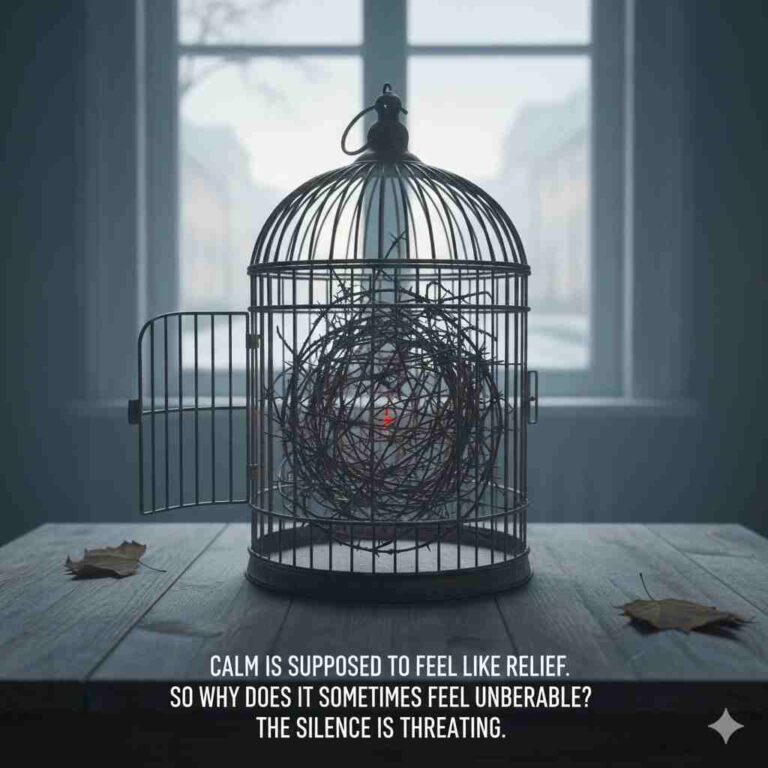
6% said when life is “too calm,” which makes their brain suspicious
The results not scientific — but human.
And humans are who I write for.
🧷How Overthinking Affects You?
Worst case?
It turns your brain into a small prison cell with no windows.
Your sleep suffers.
Your energy drains.
Your confidence shrinks.
Your decisions take forever.
Your joy becomes background noise.
Your future feels foggy.
Your mental health takes slow and quiet damage.
Overthinking is not just “thinking too much.”
It’s thinking in circles until the circle becomes a cage.
🧷How to Stop Overthinking? My Version
These aren’t “tips.” These are strategies humans actually use.
1. Label the Thought, Don’t Wrestle It
If your brain is spiraling, say:
“This is a worry, not a warning.”
Name it.
Naming things steals their power.
2. Write the Chaos Out of Your Head
Journaling isn’t cute Pinterest stuff.
It’s a mental detox.
Once your fear hits the page, it loses its teeth.
3. Scheduled Worry Time (yes, it works)
Give your brain 10–15 minutes daily to spiral on purpose.
After the timer ends, you stop.
It teaches your mind boundaries like a strict but loving parent.
4. Come Back to Your Body
Deep breaths.
Touch something textured.
Feel your feet in the ground.
The body lives in the present.
The mind lives in everywhere except the present.
5. Micro-Action > Perfect Action
Overthinking loves indecision.
So give it the opposite.
One small action — send the text, finish the task, drink water — breaks the loop.
6. Healthy Distraction:
Healthy distraction is not avoiding. It’s a reset button. Music. Crafts. A walk.
Anything that brings your brain back into rhythm.
7. Reduce Input to Reduce Spiral
Less doomscrolling = fewer imaginary disasters. Read more about mindless scrolling.

8. Talk to Someone Who Has the Antidote: Perspective
Even a 5-minute voice note with a friend can reset your brain.
Sometimes we just need someone else’s sentence to stop our own.
9. Be Kinder to Yourself Than Your Thoughts Are
Treat yourself like someone you’re trying not to lose.
Progress counts — even tiny, quiet progress.
10. Seek Professional Help When the Thoughts Get Too Loud
If overthinking leads to anxiety, depression, or affects daily life, a mental-health professional can help in ways Google can’t. Never shy from seeing a consultant.
🧷 What People Miss About Overthinking?
- It’s not weakness — it’s your brain trying too hard to protect you.
- Small steps count — pausing for even 30 seconds matters.
- Brains lie sometimes — you don’t have to believe every thought.
- Historical & psychological context matters — research shows rumination is common, adaptive in small doses, but unhealthy when chronic.
- Connection helps — perspective, social support, and structured thinking break loops.
🧷Final Note (From Me to You)
Overthinking doesn’t mean something is wrong with you.
It means your brain is trying too hard to protect you.
It’s overworked, not broken.
Every small step toward peace is still a step.
Even pausing the spiral for 30 seconds counts.
You don’t have to believe every thought just because your brain said it loudly.
Jon Kabat-Zinn said it beautifully:
“You do not have to believe everything you think.”
And honestly?
Your mind deserves that freedom.
If you’ve overcome overthinking — or you’re in the process —
you can share your story.
I’m cheering for you.
🧷Disclaimer
This piece explores psychological experiences from a human, interpretive perspective.
It is not a substitute for professional mental-health care.
If you’re struggling with anxiety, depression, or thoughts of self-harm, please reach out to qualified help.
If you’re in the U.K., call Samaritans at 116 123 or visit samaritans.org.
Elsewhere, please check local resources.
You’re not alone.





Great 👍
Glad to hear this🤍
Much needed article
Glad you liked it. Will try to upload more content of same nature.
Good information for up coming issues
Glad you liked it.
Lets overcome overthinking.. I really liked the slogan.