
Delayed Emotional Processing- Why Emotions and Feelings Arrive Late
Some feelings do not show up when they are expected to.
You go through something objectively heavy. A breakup. A loss. A health scare. A major life transition. At the time, you feel stable. Functional. Even calm.
Then, weeks or months later, the emotional weight arrives.
You cry over something small or feel anxious without a clear reason. You notice sadness or anger surfacing about something that already ended.
People around us are confused. You might be too.
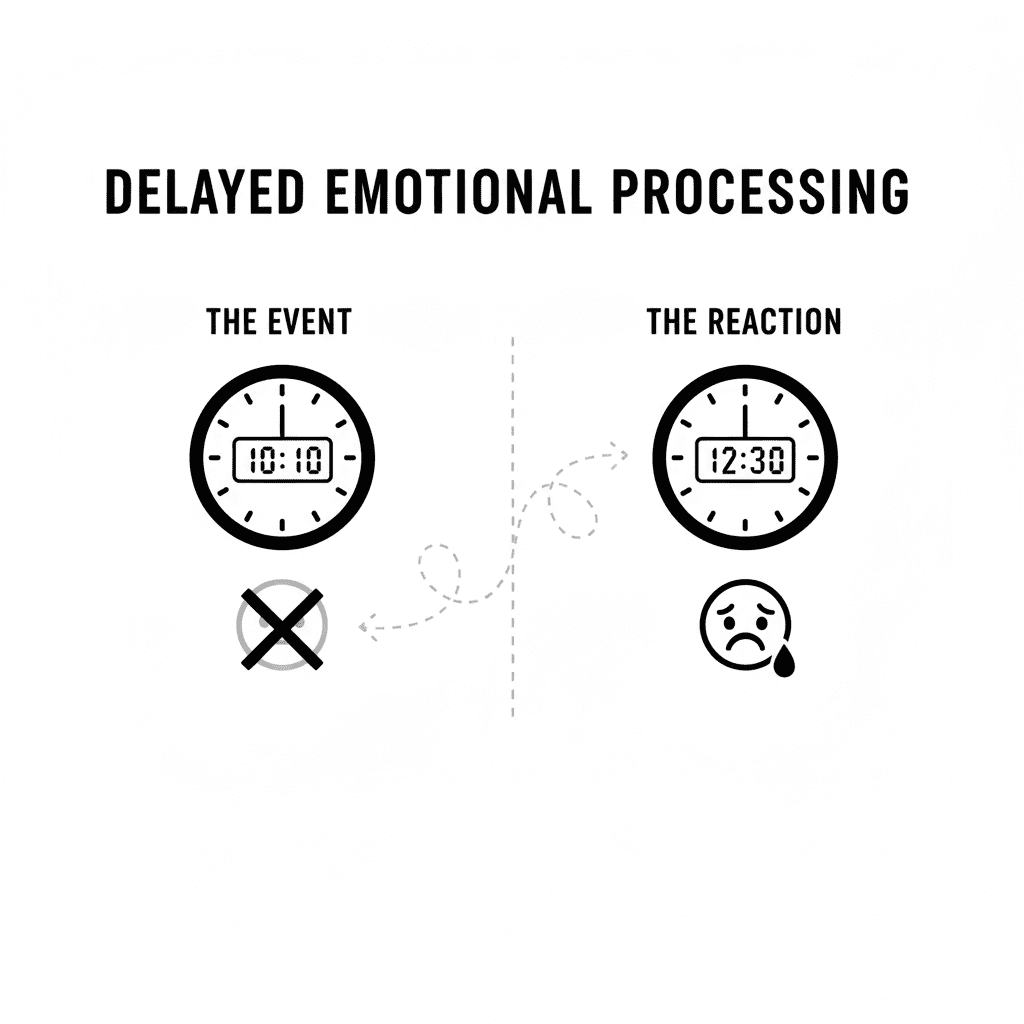
This experience has a name. It is called delayed emotional processing, and it is far more common than people realize.
🔵What Delayed Emotional Processing Actually Is
Delayed emotional processing happens when emotions are not integrated at the moment an event occurs, but instead are experienced later once life becomes less demanding.
In simple terms, you feel later what you could not feel then.
This is not denial. It is not avoidance in the dramatic sense. It is a form of adaptation.
When someone is required to function through stress, responsibility, or uncertainty, emotional depth often takes a back seat. The system prioritizes staying operational. Emotional responses are not erased. They are deferred.
Clinical psychology has long recognized this pattern, especially in the context of stress and trauma. Research shows that emotional processing can be delayed when cognitive demands are high or when immediate functioning takes priority (van der Kolk, 2014).
Nothing is lost. It is simply postponed.
🔵Why “I Was Fine at the Time” Is So Common
Many people assume that if they did not feel much during an event, then the event must not have affected them.
However, emotional timing and emotional impact are not the same thing.
During demanding periods, attention is directed toward logistics, decisions, and stability. Emotional reflection often becomes secondary. This is supported by research on chronic stress, which shows that prolonged pressure shifts mental resources toward task management rather than emotional integration (McEwen, 2007).
This is why people often say:
- “I did not have time to feel it.”
- “I was just trying to get through the day.”
- “It did not hit me until later.”
These statements are not signs of emotional avoidance. They are signs of sequencing.
🔵A Brief Example That Many Recognize
Consider someone who spends months caring for an ill parent.
During that time, they manage appointments, medications, work, and family responsibilities. They stay calm, function and do what needs to be done.
After the situation resolves, life slows down. Only then do they start feeling exhausted. Emotional. Tearful over minor things. Overwhelmed by memories they had not thought much about before.
Nothing new happened.
What changed was the space to feel. That emotional response is not delayed weakness. It is delayed arrival.
🔵Why Emotions Often Arrive After Things Settle
Emotional processing requires mental and emotional resources. When those resources are fully allocated elsewhere, emotions are often held in the background.
Neuroscience research shows that under sustained stress, the brain prioritizes predictability and control. Emotional variability becomes less accessible, not because emotions disappear, but because engaging with them is costly (Schauer & Elbert, 2010).
Once external demands decrease, the system no longer needs to stay narrowed. Emotional material that was set aside becomes accessible again.
This shift is not a malfunction. It is a transition.
Related: Mental Noise Fatigue: Why Your Brain Feels Loud Even When Nothing Is Wrong on the Outside
🔵 Immediate Emotional Processing vs. Delayed Emotional Processing
Understanding the difference between immediate processing and delayed processing is essential. Delayed processing is not only recognized by what happens after the event has passed but what happens during the event also gives clues about your nervous system.
| Delayed Emotional Processing | Immediate Emotional Processing |
|---|---|
| “I was fine back then. I don’t know why it’s hitting me now.” | “This is really affecting me right now. I need time to process it.” |
| Keeps functioning during the event and feels emotional later | Feels emotions while the event is actively happening |
| Often says, “I didn’t have time to feel it then” | Often says, “I need to talk about this now” |
| Emotions surface during calm or stable periods | Emotions surface alongside stress or disruption |
| Reactions may feel confusing or “out of nowhere” | Reactions feel directly tied to what’s happening |
| Often wonders, “Shouldn’t I be over this by now?” | Often feels validated that the emotion makes sense in the moment |
🔵Why Delayed Emotions Feel Disorienting
Delayed emotional processing often comes with confusion and self-judgment.
People wonder:
- “Why am I upset now?”
- “Did I handle this wrong?”
- “Shouldn’t I be past this?”
Social expectations add to this confusion. Emotional responses are expected to follow clean timelines. Grief is supposed to happen immediately. Closure is supposed to arrive quickly.
Real emotional processing rarely works that way.
In simpler terms, your nervous system responds to conditions, not calendars.
🔵How Delayed Processing Gets Misread
Delayed emotions are often mistaken for:
- Random anxiety
- Mood instability
- Regression
- Overreaction
Sometimes they are even pathologized.
However, research on emotional labeling shows that naming emotions after the fact can reduce distress and support integration (Lieberman et al., 2007).
The issue is not that emotions arrived late. The issue is that people do not recognize what the delay represents.
🔵Why This Pattern Is Increasing
Modern life makes delayed emotional processing more likely.
Busyness leaves little room for reflection. Productivity is often rewarded over emotional awareness. Many people are praised for being composed and low-maintenance, especially during difficult times.
Digital distraction also plays a role. Emotions are easily postponed when attention is constantly redirected.
As a result, people move forward emotionally under-processed until circumstances finally allow feelings to surface.
Related: Overthinking Is Not Over-Analyzing: The Difference Between Problem-Solving and Mental Looping
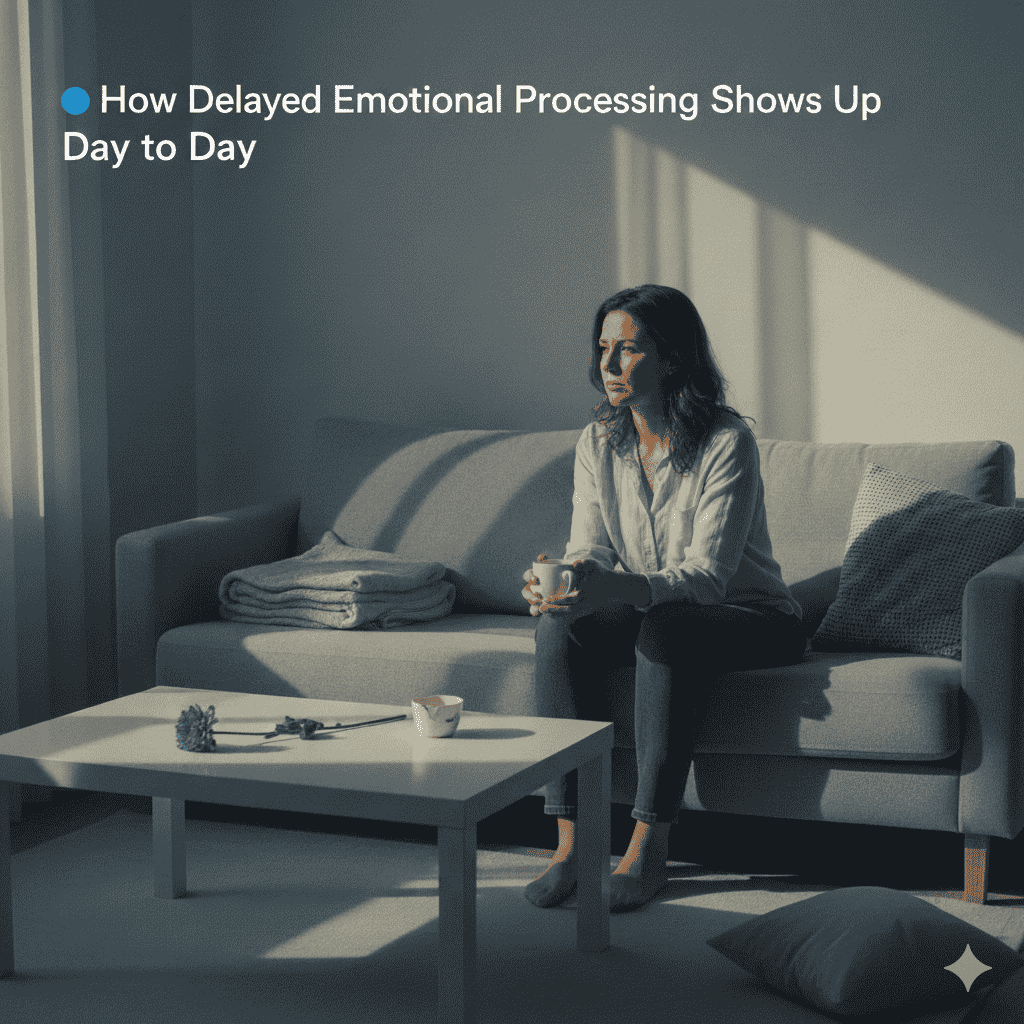
🔵How Delayed Emotional Processing Shows Up Day to Day
This rarely looks dramatic. More often, it appears as:
- Feeling emotional without a clear trigger
- Sudden heaviness during calm periods
- Strong reactions to small events
- A sense of being “off” after things improve
This is not backsliding.
It is completion of what that was left incomplete.
🔵What to do When Emotions Arrive Later
The goal is not to rush understanding or force resolution.
Instead, the goal is to allow integration, the same way you would let your body recover after a long period of strain.
1. Stop Judging The Timing
One of the most common things people say is,
“I should have felt this earlier.”
People reach out months after a breakup, a job loss, or a family crisis and say they were completely fine at the time. They handled logistics, supported others and stayed composed. Now, suddenly, they feel emotional and confused by it.
What helps is realizing that feeling now does not erase how well you coped then.
A woman once described finishing a difficult divorce feeling oddly calm. It was only after she settled into a new routine that she started crying while driving to work. Nothing new had happened. Her life had actually improved. The emotion arrived because she no longer needed to stay contained.
The timing is not wrong. It is simply later.
2. Connect Emotion to Context
People often ask,
“Why am I anxious all of a sudden?”
or
“Why am I sad when nothing is happening?”
A more useful question to ask is,
“What part of my life might this belong to?”
Someone might feel heavy months after relocating to a new country. During the move, they were focused on paperwork, housing, and survival. Once those demands eased, the loneliness and grief of leaving people behind surfaced.
The emotion is not random. It is contextual. It just did not have space earlier.
Connecting feelings to periods of life rather than searching for immediate causes helps reduce confusion and self-blame.
3. Let Emotions Exist without Analysis
Many people assume they need to understand a feeling before they are allowed to have it.
In practice, this often keeps emotions stuck.
People describe sitting with sadness and immediately trying to label it, trace it, fix it, or make sense of it. When they cannot, they feel frustrated or defective.
Often, what actually helps is allowing the emotion to be present without commentary.
A caregiver shared his demanding caregiving period. He told when it ended, he felt irritable for weeks. When he stopped asking what it meant and simply allowed the feeling to pass through, it softened on its own.
Some emotions are not asking for insight. They are asking to be felt and then released.
4. Use Low-Pressure Expression
When emotions arrive late, they do not need intense processing.
People often think they must talk everything through in one deep conversation or journal extensively until it makes sense. That can feel overwhelming.
What works better for many is low-stakes expression.
People describe walking quietly and noticing thoughts come and go. Others record short voice notes while driving, not to analyze, but to acknowledge what is there. Some talk briefly with someone they trust without trying to reach conclusions.
The key is that expression is gentle. It is not about solving anything. It is about allowing movement.
5. Expect Gradual Movement
Delayed emotional processing rarely resolves in a single moment.
People often say,
“I thought I was done with this, but it came back.”
That does not mean something went wrong.
A common pattern is waves. A few days of heaviness, then relief. Then another wave later, often softer.
Consider it as unpacking boxes after a move. You do not open everything at once. You return to different boxes over time, only when you have the capacity.
Delayed emotions integrate the same way. Slowly. In pieces. Without a final, dramatic release.
🔵A Small Reframe That Helps
Delayed emotional processing is not about catching up emotionally.
It is about finishing what could not be completed earlier.
When people understand that, they stop trying to push emotions away or rush them forward. They allow them to arrive, stay briefly, and leave.
This is not regression. It is integration happening in pieces.
🔵How This Resolves Over Time
Delayed emotional processing resolves when emotions are allowed without urgency or correction.
This does not require reliving the past. It requires letting the system finish what it set aside.
The process is usually subtle. There is no dramatic breakthrough. Instead, emotions lose intensity as they are recognized and integrated.
Related: Anticipatory Regret| Holding Back from Full Attachment and Feeling Loss Before It Happen
🔵Why This Does Not Mean You Are Behind
Delayed emotional processing often reflects resilience.
At some point, your system adapted to keep things moving. Now it is adjusting again.
That shift is not failure. It is timing.
🔵A Grounded Way Forward
If this article feels familiar, treat it as information rather than a diagnosis.
You do not need to force emotional depth or search for insight. Start by noticing when emotions surface and allowing them space without judgment.
If delayed emotions feel overwhelming or disruptive, working with a licensed mental health professional, especially one trained in trauma-informed approaches, can help with integration without pressure.
You are not late to your emotions. They arrived when conditions finally allowed them to.
🔵References
van der Kolk, B. (2014). The Body Keeps the Score. Viking.
McEwen, B. S. (2007). Physiology and neurobiology of stress. Physiological Reviews.
Schauer, M., & Elbert, T. (2010). Dissociation following traumatic stress. Journal of Psychology.
Lieberman, M. D. et al. (2007). Putting feelings into words. Psychological Science.