Functional Freeze- When You do Everything But Feel Emotionally Stuck
From the outside, you look fine; capable and reliable. You are doing what needs to be done.
Bills get paid. Messages get answered. Deadlines are met.
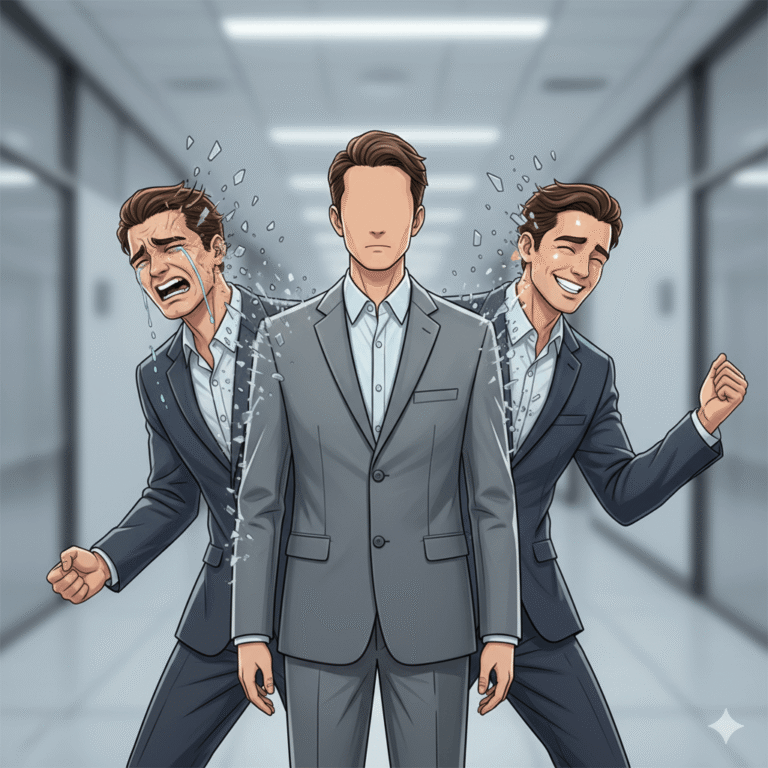
Inside, though, something feels paused. Not burned out exactly. Not anxious either. Just flat and even directionless. It’s like you are maintaining life instead of living it.
That state has a name. It is called functional freeze.

When You do Everything But Feel Emotionally Stuck
This article is written by Minhan who writes about how modern media and technology quietly shape our thoughts, emotions, and sense of self. Thier work focuses on the psychological experiences people live with but rarely know how to name.
Functional freeze is what happens when your nervous system chooses survival through consistency. You keep moving, but only enough to avoid falling apart. Growth, desire, and emotional range quietly shut down in the background.
What Functional Freeze Actually Is?
Functional freeze is not laziness. It is not a lack of motivation nor a mindset issue.
It is a nervous system response.
When stress, pressure, or emotional load lasts too long, the body adapts. Instead of staying in fight or flight, which is exhausting, it shifts into a low-level freeze state that still allows functioning. This pattern is described in trauma and stress research as a dorsal vagal response that preserves energy while reducing emotional exposure (Porges, 2011).
In simple terms, your system learns that feeling less is safer than feeling everything.
So it keeps you operational, not fully alive.
Related: Why Being Seen Feels So Uncomfortable?
Real-World Examples People Recognize Immediately
Functional freeze shows up quietly. Most people do not realize they are in it until they read something that sounds uncomfortably familiar.
Here is what it often looks like in real life.
You work all day, but nothing feels satisfying
You complete tasks, attend meetings, and cross things off lists. Yet at the end of the day, there is no sense of progress. Just relief that it is over.
You keep postponing things that matter to you
Not because you are scared, but because you feel strangely indifferent. Personal projects, creative ideas, or even simple pleasures stay on hold indefinitely.

You feel emotionally muted around people you care about
You are present, polite, and responsive, but not fully engaged. Conversations feel slightly distant, even with close friends or partners.
You default to staying busy because slowing down feels wrong
Rest does not feel relaxing. Silence feels uncomfortable. On days with nothing planned, you feel uneasy without knowing why.
You say “I’m fine” and mostly mean it, but also not really
There is no crisis to point to. Nothing dramatic enough to justify feeling off. So you keep going and stop asking questions.
These patterns are common in people who have spent long periods under pressure, responsibility, or uncertainty. Caregivers, high achievers, professionals under chronic stress, and people who had to emotionally hold it together for others often recognize this immediately.
Why Functional Freeze Is Easy to Miss?
Functional freeze hides behind competence.
- You are not falling apart, so no one worries.
- You are not complaining, so no one checks in deeply.
- You are still productive, so even you assume you must be okay.
Psychologically, this is reinforced by how society rewards output. Productivity becomes proof that nothing is wrong. Meanwhile, emotional stagnation goes unnoticed.
Research on chronic stress shows that prolonged activation can blunt emotional responsiveness over time, leading to disengagement rather than distress (McEwen, 2007). This is not collapse. It is containment.
And containment can last a very long time.
What Is Happening in the Nervous System?
Under long-term stress, the brain prioritizes predictability over growth.
The amygdala stays alert, scanning for disruption. The prefrontal cortex focuses on managing tasks and decisions efficiently. Emotional processing gets deprioritized because it is costly and unpredictable.
Neuroscience research shows that when stress is chronic, the nervous system shifts toward conservation states that limit emotional variability while preserving basic functioning (Schauer & Elbert, 2010).
That is why you can keep going but feel internally stalled.
Your system is not broken. It is protecting you by keeping things flat.
Why Motivation Advice Does Not Work Here?
This is where many people get stuck.
They try productivity hacks. Discipline. New routines. Pushing harder. None of it works for long.
That is because functional freeze is not a motivation problem. It is a safety problem.
The nervous system does not respond to logic or pressure. It responds to cues of safety and predictability. Until calm and rest are re-associated with safety, the system will resist them.
Related: Are you Habitual of Taking Stress? Calm vs. Safety
This is why people in functional freeze often feel worse when they try to relax. The absence of structure removes the protective layer that kept emotions contained.
Functional Freeze Is Not the Same as Depression
Depression often includes hopelessness, sadness, or loss of pleasure. Functional freeze is more neutral. More numb. More suspended. You are not overwhelmed by emotion. You are under-connected to it. This distinction matters.
| Aspect | Functional Freeze | Depression |
|---|---|---|
| Daily functioning | You keep showing up. Work gets done. Life looks “fine” from the outside. | Even basic tasks feel heavy or impossible. Energy is consistently low. |
| Inner experience | Emotionally stuck, numb, or on pause while still being busy. | Persistent sadness, emptiness, or loss of interest in life. |
| Motivation | You act out of obligation, pressure, or habit, not desire. | Motivation is largely absent, even for things that once mattered. |
| Emotional range | Feelings exist but feel muted, delayed, or inaccessible. | Emotions are often dominated by sadness, hopelessness, or emptiness. |
| Relationship with stress | Often developed after long-term stress, pressure, or survival mode. | May exist with or without external stressors. |
| Self-perception | “I’m doing everything, so why do I feel nothing?” | “Something is wrong with me.” |
| Clinical diagnosis | Not a diagnosis. A nervous system state or coping pattern. | A diagnosable mental health condition when criteria are met. |
Clinical literature describes this as hypoarousal rather than emotional collapse (van der Kolk, 2014). The difference is subtle, but important. Functional freeze is reversible once the nervous system feels safe enough to re-engage.
How Functional Freeze Shows Up?
There is no single version of this state.
For some people, it looks like constant busyness with no direction while for others, it looks like stability without desire.
For a few, it looks like waiting. Waiting for something to shift without knowing what.
Parents may feel it once children no longer need constant attention.
Professionals feel it after long periods of pressure finally ease.
Students feel it after years of survival-mode performance.
Different lives but same pattern.
Five Ways to Gently Move Out of Functional Freeze
This is not a reset. It is not a breakthrough. It is more like thawing your hands after being out in the cold too long. If you rush it, it hurts. If you go slowly, feeling returns.
1. Stop Asking Yourself to Feel Better
One of the first mistakes people make is trying to “get back to normal.” That pressure keeps the freeze in place.
Instead, notice what does not drain you as much. Maybe scrolling does not relax you, but sitting on the floor does. Maybe talking feels heavy, but walking in silence does not. Follow the slightly-less-exhausting option. That is the nervous system speaking quietly.
Feeling better comes later. Feeling safer comes first.
2. Make Tiny Choices Where Nothing Is at Stake
Functional freeze often comes with decision fatigue, even for small things. So stop aiming for meaningful decisions.
Choose your mug, the route to walk or what music plays in the background. Not because it matters, but because you chose it.
Those small choices rebuild agency without pressure. Over time, your system remembers that choice does not equal danger.
3. Let Your Body Move Before Your Mind Understands
When you are stuck internally, thinking harder usually makes it worse.
Instead, move without meaning. Rock slightly while standing. Stretch between tasks. Walk while listening to nothing. Do not turn it into exercise or productivity.
The body exits freeze before the mind does. Once the body feels a little safer, thoughts and emotions follow naturally.
4. Name the State Without Trying to Escape It
Saying “I’m just off” keeps the experience vague and heavy.
Saying “I think I’m in functional freeze” changes something. It removes the mystery. It removes the self-judgment.
You are not broken. You are paused. And pauses end.
Simply naming the state creates distance between you and the feeling. You stop fighting it and start observing it.
5. Look for Interest, Not Passion
Do not wait for motivation. That comes much later.
Instead, notice what holds your attention for a few seconds longer than usual. A topic you read about. A song you replayed. A thought that lingered.
That is not excitement. It is a flicker. And flickers are how thawing starts.
You are not supposed to want everything back at once. You are supposed to notice when something gently pulls you forward instead of pushing you.
Why This State Does Not Mean You Are Stuck Forever
Functional freeze is adaptive. That means it can adapt again.
The nervous system learns through experience, not insight. As safety, choice, and low-pressure engagement accumulate, emotional range gradually returns.
This is not a dramatic breakthrough. It is a quiet thaw.
Related: Silent Burnout: Why You’re Exhausted Even When Life Looks Fine?
What Functional Freeze Ultimately Reveals
Functional freeze is not failure. It is evidence that you survived something demanding.
Your system learned how to hold things together when it mattered. Now it needs permission to let go of that role.
Feeling unstuck does not start with doing more. It starts with letting safety replace urgency.
And when movement returns, it does not feel explosive. It feels subtle. Like noticing you care again.
A Gentle Way Forward
If this article feels uncomfortably accurate, take that as information, not a diagnosis.
You do not need to fix yourself. You need to listen differently.
If you want structured support, a licensed mental health professional trained in trauma-informed or nervous-system-based approaches can help retrain safety without forcing emotional exposure.
Functional freeze lifts when safety becomes real again.
And it can.
References
- Porges, S. W. (2011). The Polyvagal Theory. Norton.
- McEwen, B. S. (2007). Physiology and neurobiology of stress. Physiological Reviews.
- Schauer, M., & Elbert, T. (2010). Dissociation following traumatic stress. Journal of Psychology.
- van der Kolk, B. (2014). The Body Keeps the Score. Viking.
- Lieberman, M. D. et al. (2007). Putting feelings into words. Psychological Science.