
Identity Lag- What Happens When Life Changes Faster than Self Image
There are moments in adult development when your external life updates before your internal identity does. The promotion happens. The move becomes permanent. The relationship ends. The new circle forms. The responsibility increases.
On paper, everything has shifted.
Internally, however, you still feel like the previous version of yourself.
This gap is what psychologists often describe as identity lag. It refers to the delay between external change and internal self-concept adjustment. While life transitions can occur quickly, self-image recalibrates more slowly. When that recalibration lags behind, dissonance forms.
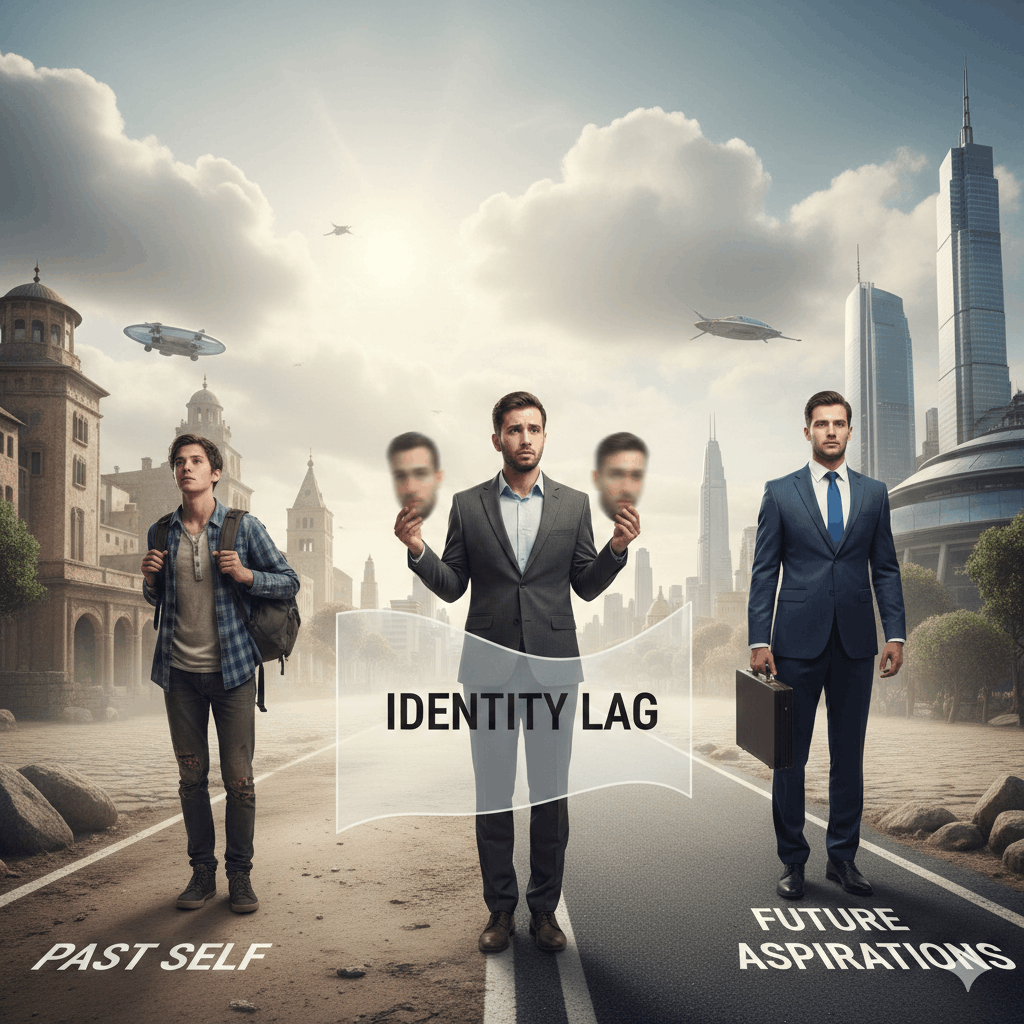
Identity lag is not immaturity. It is a predictable feature of identity development.
The Architecture of Self-Image
Self-image is not a mirror. It is a memory structure.
It is built from repeated experiences, reinforced roles, and social feedback accumulated over time. If you were “the struggling one,” “the quiet one,” “the dependent one,” or even “the high achiever,” those identities were formed through consistency.
When circumstances shift abruptly, the brain does not instantly update the narrative. It continues operating from the old template because that template feels familiar and neurologically efficient.
For example, someone who grew up feeling overlooked may still internally brace for dismissal even after entering environments where they are respected. Someone who experienced prolonged instability may struggle to internalize safety even when their life becomes stable.
The outer environment changes first. The internal schema updates later.
That delay creates identity lag.
When Growth Outpaces Self-Concept
Phase 3 identity development often involves accelerated change. Values solidify. Boundaries strengthen. Social environments shift. You may leave old communities, advance professionally, or detach from relationships that once defined you.
Objectively, you have grown.
Subjectively, you may still feel like the earlier version of yourself.
This produces a specific kind of psychological tension known as self-discrepancy. Self-discrepancy theory explains that distress emerges when there is a gap between who you believe you are and who your current life reflects.
You might think:
- I am not ready for this level of responsibility.
- I am pretending.
- I am one mistake away from being exposed.
Even when evidence contradicts these thoughts.
Identity lag often masquerades as impostor syndrome, but they are not identical. Impostor syndrome centers on fear of incompetence while identity lag centers on outdated self-definition.
| Category | Identity Lag | Impostor Syndrome |
|---|---|---|
| Core Definition | A delay between external growth and internal self-image updating. | A persistent belief that one’s success is undeserved or fraudulent despite evidence of competence. |
| Primary Psychological Gap | Mismatch between current life circumstances and outdated self-concept. | Mismatch between demonstrated competence and internal feelings of inadequacy. |
| Central Fear | “This new version of me doesn’t feel real yet.” | “I will be exposed as incapable.” |
| Focus of Doubt | Identity-based (“Who am I now?”) | Ability-based (“Am I actually competent?”) |
| Emotional Tone | Disorientation, lag, adjustment tension. | Anxiety, fear of exposure, chronic self-doubt. |
| Trigger | Rapid life transitions (promotion, relocation, financial shift, role change). | Achievement, recognition, or increased responsibility. |
| Relation to Evidence | Evidence is accepted intellectually but not fully embodied. | Evidence is dismissed or attributed to luck, timing, or external factors. |
| Resolution Path | Identity integration through repetition, reflection, and alignment. | Cognitive reframing, confidence-building, and challenging distorted beliefs. |
| Long-Term Outlook | Often temporary during developmental transitions. | Can become chronic without intentional intervention. |
One questions ability.
The other questions identity.
Why the Brain Resists Updating
From a cognitive perspective, updating identity is metabolically expensive. The brain prefers consistency. It relies on stored narratives to predict outcomes and maintain stability.
When your life changes rapidly, prediction models fail. The brain compensates by clinging to familiar identity scripts.
If you were once financially unstable, you may still think in scarcity terms even after achieving security. If you were once socially anxious, you may still internally prepare for rejection even when social dynamics have improved.
Related: Outgrowing People Without a Big Reason- When Relationships Fade Without Betrayal
These responses are not evidence that growth is fake. They are evidence that your nervous system has not fully integrated new data.
Integration takes repetition.
External Validation Does Not Fix It
A common misconception is that once circumstances improve, confidence should automatically follow.
In practice, external validation rarely overrides long-standing self-concepts. Praise may register intellectually but fail to reshape internal identity. Achievements may accumulate without fully altering self-perception.
This is because identity is not updated through single events. It changes through consistent experiential reinforcement.
In early adulthood and early thirties especially, identity transitions can outpace integration. Career acceleration, relational shifts, geographic moves, and financial changes may occur within short timeframes. Internally, however, identity recalibration unfolds gradually.
The result is a persistent feeling of being “behind” your own life.
The Emotional Experience of Identity Lag
Identity lag does not always feel dramatic. Often, it feels subtle and disorienting.
You may feel:
- out of place in environments you objectively belong in
- surprised when others treat you as capable
- hesitant to claim progress you have clearly made
There may be pride, but it feels distant. There may be success, but it feels fragile.
Internally, you still relate to yourself as the earlier version. That earlier version may have been insecure, uncertain, or underestimated. Even if those traits are no longer accurate, they remain embedded in self-image.
This creates a sense of living in two timelines at once.
The Risk of Reverting to Old Roles
One consequence of identity lag is regression to familiar patterns.
- If you still see yourself as the unreliable one, you may unconsciously undermine new stability.
- If you still identify as the caretaker, you may overextend even when boundaries are stronger.
- If you still view yourself as “behind,” you may avoid opportunities that confirm growth.
Psychologists refer to this as role preservation behavior. When identity feels threatened by change, behavior may subtly align with the older self-concept to restore coherence.
In other words, you may act smaller than your current life requires.
Not because you lack capacity, but because your internal narrative has not caught up.
Distinguishing Identity Lag From Denial
It is important to differentiate identity lag from denial.
Denial involves rejecting reality. Identity lag involves delayed integration of reality.
In denial, evidence is dismissed.
In identity lag, evidence is acknowledged but not embodied.
You may fully recognize your growth intellectually while still feeling emotionally anchored to your past identity.
That distinction matters because the solution is different. Identity lag does not require confrontation. It requires integration.
How Identity Integration Actually Happens
Identity does not update because you understand something once. It updates because your brain accumulates consistent evidence that the old story is outdated.
Integration follows three mechanisms: repetition, reflection, and behavioral congruence.
1. Repetition: New Evidence Must Become Boring
The brain does not revise identity after a single success. It revises identity after repeated exposure to the same new reality.
For example, imagine someone who has always seen themselves as “bad at leadership.” They get promoted unexpectedly. At first, every meeting feels like an audition. Every mistake feels like confirmation they do not belong.
However, six months later, they have:
- led multiple projects
- navigated conflict
- made difficult decisions
- received neutral or positive feedback consistently
Eventually, the novelty fades. Leadership stops feeling like an exception. It starts feeling routine.
That moment, when competence becomes boring rather than shocking, is when identity begins to shift.
Repetition reduces internal resistance. It teaches the nervous system that the new role is not temporary.
2. Reflection: Naming the Change Makes It Real
Growth that is not consciously acknowledged often goes unintegrated.
Without reflection, people can achieve things while still narrating themselves as stuck. This is common during rapid life transitions.
Consider someone who moved cities, built new friendships, and stabilized financially within a year. If they never pause to examine those shifts, they may still internally describe themselves as “lost” or “behind.”
Related: Delayed Emotional Processing- Why Emotions and Feelings Arrive Late
Reflection interrupts outdated narratives.
This can look like:
- writing down evidence of growth
- comparing past reactions to current ones
- noticing how differently you handle situations that once overwhelmed you
For example, you may realize that you now set boundaries in conversations that previously drained you. That shift deserves recognition. When you articulate it, your identity updates from “people-pleaser” to “someone learning to protect their energy.”
Reflection turns experience into integration.
3. Behavioral Congruence: Acting in Alignment Rewires Identity
Self-image strengthens through action.
If you intellectually believe you are more confident but continue behaving as if you are powerless, your identity will default to the behavior, not the belief.
Congruence means behaving in ways that match your current values and growth, even when it feels unfamiliar.
For example:
- If you see yourself as more selective about relationships, you decline invitations that feel misaligned.
- If you recognize increased competence, you speak up in meetings instead of deferring automatically.
- If you identify as emotionally healthier, you address conflict directly rather than withdrawing.
Each aligned action reinforces the updated identity.
At first, these behaviors feel intentional and effortful. Over time, they become automatic. That shift signals integration.
4. Social Feedback: Allowing Others to See the Updated Version
Identity is partly internal and partly relational. Other people’s responses help stabilize self-concept.
When someone consistently treats you as capable, grounded, or authoritative, it can feel uncomfortable if your internal identity has not caught up. The instinct may be to deflect praise or minimize responsibility.
Integration requires tolerating updated perceptions.
For instance, if colleagues now seek your advice, instead of dismissing it as a fluke, you allow yourself to sit in that recognition. If friends describe you as steady or self-assured, you resist correcting them with outdated self-criticism.
Accepting new feedback without shrinking accelerates identity recalibration.
5. Time: Psychological Settling Is Gradual
Even with repetition, reflection, and congruent behavior, integration takes time.
There is often a quiet period where the new identity feels real in some moments and foreign in others. This fluctuation is normal. It does not mean growth is unstable.
Over months or years, the gap narrows.
You stop feeling surprised by your own competence. You stop referencing your past as the primary evidence of who you are. The updated identity begins to feel neutral rather than aspirational.
When that happens, identity lag closes.
Why Identity Lag Is a Developmental Marker
Identity lag is not a flaw. It often indicates rapid development.
When life expands, identity needs time to recalibrate. The discomfort signals that the old structure no longer fits, even if the new one has not fully settled.
In Phase 3, this recalibration is common because identity is actively consolidating. Roles chosen out of circumstance are being replaced by roles chosen out of alignment.
That replacement takes cognitive and emotional processing.
Preventing the Self-Image From Staying Stuck
While time is necessary, passive waiting is not sufficient. Without intentional reflection, identity lag can harden into chronic under-identification with growth.
Practical integration strategies include:
- Documenting evidence of change rather than relying on memory.
- Updating personal narratives consciously, for example shifting from “I am bad at leadership” to “I am learning leadership and have handled X successfully.”
- Allowing others’ updated perceptions of you to inform, rather than threaten, your self-image.
The goal is not ego inflation. It is accuracy.
Identity should reflect present reality, not outdated survival narratives.
When Identity Finally Catches Up
Eventually, something shifts.
You stop feeling surprised when someone trusts you or stop bracing for exposure in rooms you have already earned.
You stop mentally referencing your past as proof of limitation.
Related: Anticipatory Regret- Holding Back from Full Attachment and Feeling Loss Before It Happen
The new version of you begins to feel familiar.
Identity lag closes quietly. There is no dramatic moment of transformation. Instead, there is a steady sense of alignment between inner narrative and outer life.
This alignment reduces cognitive strain and increases psychological stability.
A Necessary Clarification
Identity lag is a common developmental experience during periods of accelerated change. It is not a clinical diagnosis. Persistent distress, severe anxiety, or functional impairment should be evaluated in appropriate professional contexts.
However, temporary dissonance during growth is expected.
Final Thoughts:
Life can move quickly. Identity does not.
When your circumstances expand faster than your self-image, disorientation is natural. The solution is not to slow growth or shrink back into older roles. It is to allow time and repetition to integrate the change.
Phase 3 is not only about evolving externally. It is about updating internally.
Sometimes the hardest part of growth is not becoming someone new.
It is recognizing that you already have.