Overthinking Is Not Over-Analyzing: The Difference Between Problem-Solving and Mental Looping
As from the previous article, Why Being Seen Feels So Uncomfortable? (You’re Not Broken)-our readers know that we have started a series of articles that aims “Naming the Unnamed”. Now, with this piece of writing, we kick off the second phase of the series that will explain thoughts and emotional patterns people often misread.
Overthinking has become one of the most misused words of the internet era.
People say they are overthinking when they are actually preparing.
They say they are overthinking when they are reflecting.
And sometimes, they are told to “stop overthinking” when what they are really doing is trying to understand something that matters.
But there is a real mental pattern that deserves the name overthinking.
And it is not the same as analyzing deeply or thinking carefully.

The difference matters; because one helps you move forward, and the other quietly drains you while pretending to be useful.
This article explores how to tell the difference between over-analyzing(healthy analysis) and over-thinking(anxiety-driven mental looping), why modern life makes the over-thinking more common, and how to gently step out of it without shutting down your mind.
🍄 Why Everything Feels Like Overthinking Now
We live in a world that rewards constant cognition.
Notifications, opinions, choices, comparisons, decisions — the brain rarely gets a full stop. Thinking becomes background noise, not a tool you pick up and put down.
At the same time, people are encouraged to “optimize” every aspect of life: careers, relationships, habits, emotions, even rest. When something feels uncomfortable, the instinct is to think harder.
So when mental exhaustion hits, it all gets labeled as overthinking.
But not all thinking is the problem.
The specific type of thinking is.
🍄 What Over-Analyzing Actually Is?
Despite the negative reputation, over-analyzing is not inherently unhealthy. It is goal-directed cognition.
You analyze when:
- You are trying to understand a situation
- You are weighing options
- You are solving a defined problem
- You reach a conclusion or next step
Over-analysis can feel tiring, but it has movement. There is progression.
Cognitive psychology describes this as deliberative processing, largely involving the prefrontal cortex, the part of the brain responsible for planning, reasoning, and decision-making (Evans & Stanovich, 2013).
Even when it’s intense, it tends to end with:
- A decision
- A boundary
- A plan
- Or a conscious pause
It closes loops.
🍄 What Overthinking Actually Is
Overthinking is not about complexity. It is about repetition without resolution.
Overthinking is what happens when the brain gets stuck trying to create certainty where none exists, especially around emotional or relational uncertainty.
It often looks like:
- Replaying conversations
- Imagining future scenarios
- Questioning past decisions repeatedly
- Mentally rehearsing outcomes that never arrive
Related: What Is Overthinking? Signs, Causes, and How to Stop It
Clinical literature links this to rumination and worry, both of which are associated with anxiety-related processes rather than problem-solving (Nolen-Hoeksema et al., 2008).
Unlike analysis, overthinking does not move toward action.
It loops.
🍄 The Core Difference: Over-Analyzing vs. Over-Thinking
Here’s the simplest way to tell them apart:
- Over-analyzing is directional
- Overthinking is protective
Over-analyzing asks: What can I do?
Overthinking asks: How do I avoid feeling unsafe?
Anxiety-driven thinking is less about solutions and more about control. The mind keeps scanning, replaying, and forecasting because uncertainty feels threatening.
| Over-Analyzing | Overthinking |
|---|---|
| Leads to decisions or clearer understanding | Leads to repetition without real closure |
| Has a clear beginning and a natural end | Feels ongoing, circular, and hard to stop |
| Feels effortful but purposeful | Feels urgent but directionless |
| Clarity increases as you think it through | Mental fatigue increases the longer it loops |
| Driven by curiosity and problem-solving | Driven by anxiety and the need for certainty |
Neuroscience research shows that anxiety increases activity in the default mode network i.e. the brain system involved in self-referential thinking and mental simulation (Hamilton et al., 2011). This makes thoughts louder, more repetitive, and harder to disengage from.
The brain is not trying to solve the problem.
It is trying to reduce discomfort.
🍄 How Modern Life Fuels Mental Looping
Mental looping is not a personal failure. It is a predictable response to modern conditions.
1. Constant information access
The brain evolved to resolve uncertainty with limited data. Now it has infinite data and no natural stopping point.
2. Social comparison
Overthinking thrives when decisions feel tied to identity, worth, or visibility. Social media turns ordinary choices into perceived judgments.
3. Emotional suppression
Many people are taught to think through emotions instead of feel through them. When feelings are not processed somatically, they return cognitively.
4. Chronic low-grade stress
Long-term stress sensitizes the nervous system, making the mind more vigilant and less tolerant of ambiguity (McEwen, 2007).
The result: a brain that stays busy even when nothing urgent is happening.
🍄 Real-World Signs You’re Overthinking
People often recognize overthinking only after seeing it described.
You might be overthinking if:
- You revisit the same thought without gaining new insight
- Thinking makes you more tired, not clearer
- You feel “mentally busy” but inactive
- Your thoughts are emotionally charged but unproductive
- You feel relief only when distracted, not when resolved
People often say:
“I know this already, but my brain won’t let it go.”
“I’ve thought about this a hundred times and still feel stuck.”
“I’m not confused — I’m just exhausted.”
Those are not analysis problems.
They are nervous system problems.
Related: Why Being Seen Feels So Uncomfortable? (You’re Not Broken)
🍄 Why “Just Stop Overthinking” Never Works
Telling someone to stop overthinking is like telling a fire alarm to calm down.
Anxiety-driven thought loops are automatic safety behaviors. They are not controlled by logic alone.
Studies show that thought suppression often backfires, increasing the frequency and intensity of unwanted thoughts (Wegner, 1994). The brain interprets suppression as threat confirmation.
The more you try to shut it down, the louder it gets. This is why people feel worse when they try to “think positive” or force clarity.
The system does not need discipline. It needs safety.
🍄 One Practical Shift That Actually Helps
Instead of asking:
“How do I stop thinking about this?”
Ask:
“Is this thought helping me decide, or helping me feel safer?”
If it’s helping you decide — continue. Write it down. Structure it. Finish the loop.
If it’s trying to make you feel safer — logic won’t end it.
That’s when you shift out of cognition and into regulation.
Regulation can look like:
- Grounding in the body (movement, temperature, breath)
- Reducing input (silence, fewer screens)
- Externalizing thoughts onto paper
- Allowing uncertainty instead of resolving it
The goal is not to answer the thought. The goal is to lower the nervous system’s need to repeat it.
🍄 How to Gently Exit Mental Looping
This isn’t about forcing clarity. It’s about changing state.
Overthinking doesn’t end because you finally “figure it out.”
It ends when your system no longer feels like it has to keep scanning.
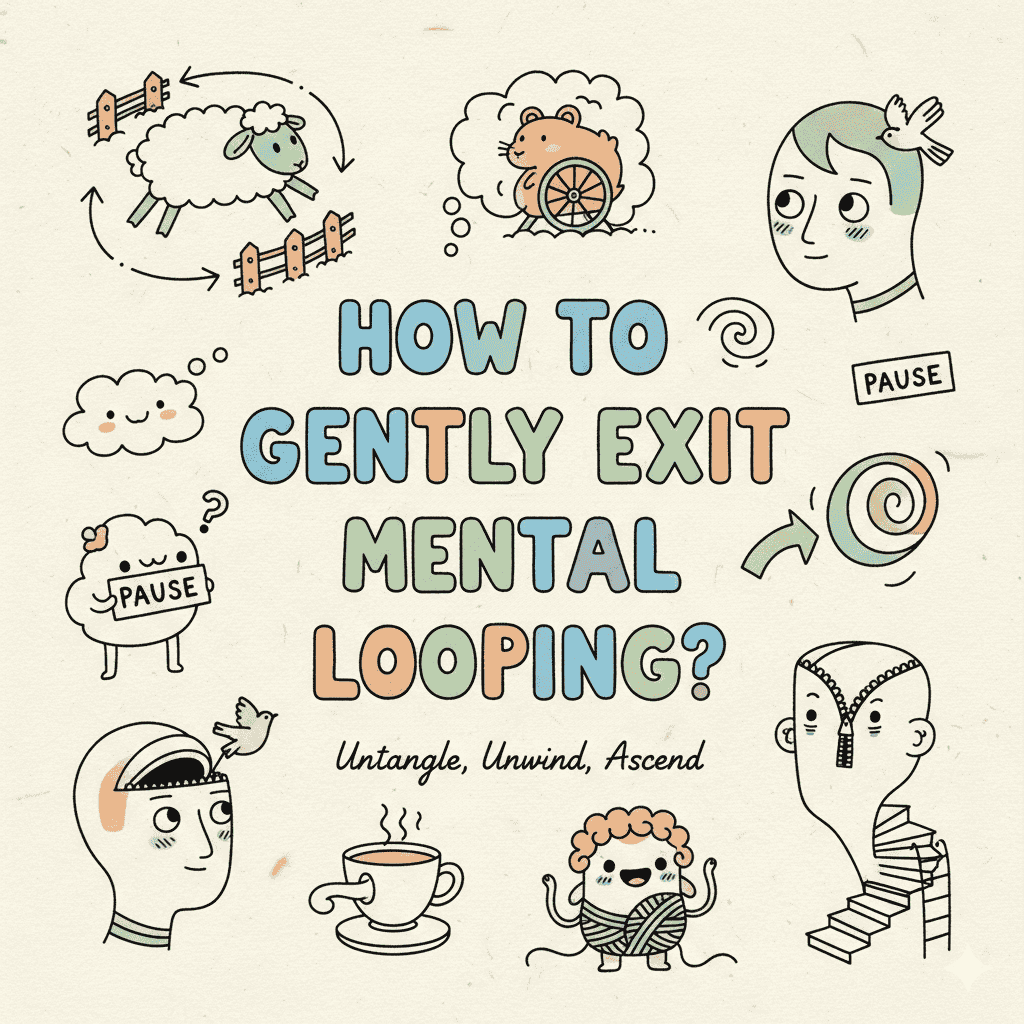
These shifts are small on purpose. They work in real life, not ideal life.
1. Contain the thought instead of carrying it all day
When a thought keeps looping, your brain is trying to make sure it doesn’t get lost.
So give it a place.
Write it down once. Not to solve or optimize, just to get it out of your head and onto something solid. One page. One note. Then stop.
This isn’t avoidance. It’s containment.
Your brain relaxes when it knows the thought has been “stored” somewhere safe.
You’re not ignoring it. You’re giving yourself a break from holding it.
2. Interrupt with sensation, not reasoning
Overthinking lives in abstraction — past conversations, imagined futures, “what ifs.”
The fastest way out isn’t thinking better.
It’s coming back into the body.
That might look like:
- Washing your hands with warm water and noticing the temperature
- Standing up and stretching without turning it into exercise
- Stepping outside and feeling the air for a moment
Nothing dramatic. Nothing productive.
Sensation reminds your nervous system that you’re here, now, and not in danger. Once that happens, the thoughts naturally lose volume.
3. Delay engagement instead of demanding answers
Most looping thoughts feel urgent, even when they aren’t.
Try this instead:
“I’ll come back to this later.”
Not forever. Not never. Just later.
What often happens is surprising — the thought doesn’t feel as important once the urgency passes. Or it comes back softer, clearer, and easier to handle.
Overthinking thrives on immediacy. Space weakens it.
4. Name what’s happening without judging it
When you’re inside a loop, it feels personal — like you are the problem.
Naming the pattern creates distance.
“This is anxiety looping.”
“This is my brain looking for certainty.”
“This isn’t a decision — it’s a stress response.”
You’re not dismissing the thought.
You’re changing your relationship to it.
The moment it becomes something happening rather than who you are, it loses some control.
5. Practice leaving some questions unfinished
This one is uncomfortable, and that’s why it matters.
Some questions don’t resolve with more thinking:
- Did I say the wrong thing?
- What if this goes badly?
- What does this mean about me?
Overthinking keeps you busy so you don’t have to sit with not knowing.
Learning to say, “I don’t have to answer this right now” is a skill — and a form of emotional maturity.
Certainty feels safe. But tolerance for uncertainty is what actually quiets the mind.
🍄The Part People Miss
Overthinking fades when safety increases — not when certainty appears.
You don’t exit mental looping by outsmarting your mind.
You exit it by letting your system feel less on edge.
And that starts with small moments of relief, not big insights.
If this section feels familiar, that’s not a failure.
It’s your nervous system asking for a different kind of support.
Quiet doesn’t come from answers.
It comes from feeling allowed to pause.
🍄Why This Doesn’t Mean You’re Bad at Thinking
People who overthink are often intelligent, reflective, and conscientious. The issue is not too much thinking.
It’s thinking used as emotional armor. Once the nervous system feels safer, the mind naturally becomes quieter and more selective.
You don’t lose your depth. You just regain your direction.
🍄 A Clear Way Forward
If this article feels uncomfortably accurate, that’s not a flaw, it’s awareness.
Start by noticing when your thinking helps you act and when it traps you in loops. That distinction alone changes how much power those thoughts have.
If mental looping has become constant or overwhelming, working with a licensed mental health professional, especially one trained in anxiety or nervous-system-based approaches can help retrain safety without silencing your mind.
You don’t need to think less.
You need to think with support instead of fear.
And that’s learnable.
🍄 References
Evans, J. S. B. T., & Stanovich, K. E. (2013). Dual-process theories of higher cognition. Perspectives on Psychological Science.
Nolen-Hoeksema, S., Wisco, B. E., & Lyubomirsky, S. (2008). Rethinking rumination. Perspectives on Psychological Science.
Hamilton, J. P. et al. (2011). Default-mode and task-positive network activity in anxiety. Biological Psychiatry.
McEwen, B. S. (2007). Physiology and neurobiology of stress. Physiological Reviews.
Wegner, D. M. (1994). Ironic processes of mental control. Psychological Review.