
How to Build Mental Resilience in High-Pressure Environments
When I was in college, me and my friend used to walk to college together. It took fifteen minutes on the same route. One day, he was absent so I went alone. After college turned off, I was coming back with some other fellows following a different path.
When I separated from them and crossed the road, that is when I saw her. Very old. Seventy-five, maybe eighty. Standing on the roadside. Carrying a 5 kg cooking oil carton. By her looks, I was surprised. She did not look rich enough to buy a 6000 rupees oil carton.
She called me to help her carry it. First, I didn’t want to because she was a stranger. Totally unknown. But then I went and picked up the carton.
On the way, she started asking me things. Where I live. How old I am. Stuff like that. I dodged and told her all wrong answers. She kept walking and taking me inside different streets. Then we reached a house. When I looked up, there were big guys, five or six of them on the roof. Smoking. Some vaping.
At the corner of that street, her voice rose strangely. Like she wanted those boys to know and open the door.
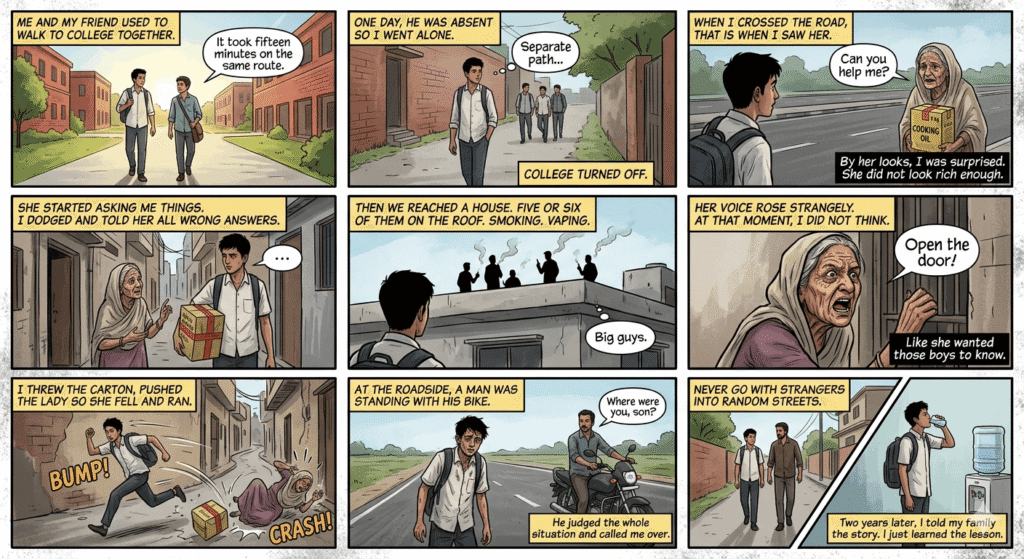
At that moment, I did not think. I threw the carton, pushed the lady so she fell and ran. My bag was bouncing against my back on random streets. I had no idea where to run but that was the only solution left; to run.
And then I saw it, one street that led back to the road we came from. I reached there and looked back. Those guys were still following me.
At the roadside, a man was standing with his bike. Thirty-five, forty years old. When he saw my face — I don’t know how — he judged the whole situation and called me over. The boys stopped. The stranger started talking loudly. Like he knew me.
“Oh, where were you, son? I have been here for thirty minutes.”
He walked me home. When we reached the last street, I bid him farewell. I didn’t want my parents to worry. So, I stood there for ten minutes, drank water and walked home completely normal.
Two years later, I told my family the story. While laughing. I wasn’t traumatized. I just learned the lesson. Never go with strangers into random streets.
But here is what I did not tell them. I still remember the oil carton. The roof. The bike. The man’s voice. The way my lungs burned. The way I looked in that window and did not recognize my own face.
Every article about mental resilience tells you the same things. Sleep more, exercise, meditate, set boundaries, find meaning, purpose, take breaks. These are not wrong. Instead, they are answers for a world where pressure is occasional, not a lifestyle.
This article is not that. So let me tell you what I have learned about mental resilience since then. Not from books. From almost not making it home.
What Mental Resilience Actually Is (And What It Is Not)
Mental resilience is not the absence of breaking. It is not staying calm when everything is on fire. It is not being the person who never needs help.
Mental resilience is the capacity to break and keep going. To fall apart in private and reassemble in time for the next demand, feel the weight and still move, be exhausted and still show up. It means to carry what you cannot put down.
The world sells you a lie about resilience and endurance. It sells you the image of the stoic leader, the unshakeable surgeon, the calm pilot, the parent who never cracks. Those people do not exist. They are masks. And wearing the mask is not resilience. It is performance. And performance exhausts you faster than the work itself.
Here is the truth about mental resilience that no one tells you: Resilience is not about being stronger. It is about learning to distribute weight. It is about knowing which muscles to tense and which to release and knowing when to hold and when to let something fall.
The most resilient people you know are not the ones who never struggle. They are the ones who have learned how to struggle without disappearing.
The Core Question This Article Answers
“How do I keep showing up under pressure without destroying myself in the process?”
The short answer: You stop trying to be unbreakable. You build systems that catch you when you crack. You separate your worth from your performance. And you learn the difference between pressure that builds and pressure that destroys.
The long answer requires understanding the hidden architecture of resilience, the parts no one teaches because no one talks about them.
The First Truth: You Will Break. Plan For It.
Every article about resilience assumes you can hold everything together if you just try hard enough. This is a lie.
You will break. Not maybe. Not if things get really bad. You will break. The question is not whether you will break. The question is what happens after.
True mental resilience is not about preventing the break. It is about designing the recovery before you need it.
The practice: Identify your break indicators. The small signs that you are approaching your limit. Not the catastrophic collapse. The whispers before the scream.
- You stop sleeping through the night.
- You start dreading things you used to tolerate.
- You feel nothing when you should feel something.
- You feel everything when you should feel nothing.
- Small tasks feel like mountains.
- You cannot remember the last time you laughed without forcing it.
Name your indicators. Write them down. Keep them somewhere you will see them. When three of them appear, you do not wait. You activate your recovery protocol before you need it.
The most resilient people do not break less often. They catch themselves earlier.
The Second Truth: Separate Your Worth From Your Output
High-pressure environments are masters at fusing your identity with your performance. You are not a person who does a job. You become the job. So the cycle continues like this:
- When the job goes well, you are good.
- When the job struggles, you are failing.
- When the job stops, you disappear.
This fusion is the fastest path to collapse.

The practice: Every day, name one thing that is true about you that has nothing to do with what you produce.
- “I am someone who notices small kindnesses.”
- “I am someone who makes my partner laugh.”
- “I am someone who remembers my childhood dog’s name.”
- “I am someone who likes the sound of rain.”
These seem small but actually not that small. They are anchors. When the pressure crushes everything else, these anchors keep you from floating away entirely.
Mental resilience is not about being strong enough to carry the weight. It is about remembering that you exist outside the weight.
The Third Truth: Build a Second World
High-pressure environments demand everything. They will take all of your attention if you let them. And if you let them, there will be nothing left when they finally release you.
The practice: Build a second world. Something that exists completely outside your pressure environment. That makes no money, produces nothing, impresses no one. Something that is only for you.
- A garden that no one sees.
- A instrument you play badly but love.
- A notebook no one will read.
- A morning ritual that belongs to no company, no client, no deadline.
This second world is not a hobby. It is a lifeline. It is proof that you exist when the pressure stops. It is where you go to remember that you are a person, not a function.
The most resilient people do not wait for burnout to build a second world. They build it while they are still standing. Because they know that building it while standing is the only way it will be there when they fall.
Related: What Comes After Survival Mode? It’s a Journey of Rebuilding
The Fourth Truth: Learn the Difference Between Pressure and Threat
This is the most important distinction in this article. Read it twice.
Pressure is a demand that exceeds your current resources. Threat is a demand that exceeds your capacity to survive. First one can be managed but the latter requires escape.
High-pressure environments constantly blur this line. They tell you that everything is urgent. That everything will collapse if you fail and every mistake is catastrophic.
Most of what they tell you is pressure is actually just noise.
The practice: When you feel the weight, ask one question: “If I fail at this, will I die? Will someone I love die? Will I lose everything I cannot rebuild?”
If the answer is no, it is pressure not threat. Pressure is survivable, manageable and can even be useful. It sharpens, focuses and reveals what matters.
But only if you stop treating it like threat. Threat activates your nervous system’s emergency response. Pressure requires your executive function. You cannot use executive function when your brain thinks you are being hunted.
Mental resilience is not about handling threat better. It is about recognizing that most of what you are handling is not actually threat.
The Fifth Truth: Build a Recovery Ritual, Not a Recovery Plan
Plans fail and require time you do not have. I believe planning is assuming the world will cooperate.
Rituals are different. They are small, portable, repeatable, do not ask for permission and do not require ideal conditions.
The practice: Design a three-minute recovery ritual. Something you can do anywhere, anytime, without equipment, without privacy, without anyone noticing.
- Three breaths where the exhale is twice as long as the inhale.
- Pressing your feet into the floor and noticing the pressure.
- Naming three things you can see, three you can hear, three you can feel.
- Putting one hand on your chest and one on your belly and waiting for your heartbeat to slow.
This is not meditation. It is survival maintenance. This is the emotional equivalent of checking your mirrors. You are not trying to achieve enlightenment. You are trying to keep the car on the road.
Do it every hour. Not when you are already drowning. Every hour. Before you need it.
The Sixth Truth: Let Some Things Burn
This is the hardest truth. And the most necessary.
High-pressure environments thrive on your belief that everything matters equally. They want you to believe that missing a deadline is the same as losing a client is the same as disappointing a colleague is the same as failing a child.
It is not.
The practice: Each week, identify one thing you will let burn. One task you will not do. One email you will not answer. One meeting you will not attend. One standard you will not meet.
Not because you are lazy. Because you are protecting your capacity for the things that actually matter.
The most mentally resilient people are not the ones who do everything. They are the ones who know what they can afford to lose.
Related: How to Rest Without Guilt: 5 Science-Backed Strategies That Actually Work
The Seventh Truth: Find Your People
Resilience is not individual. The myth of the lone resilient hero is a lie. No one survives high pressure alone.
The practice: Identify three people who see the same pressure you see. Not people who will fix you. Not people who will tell you to meditate. People who will sit in the fire with you and not pretend it is not hot.
- One person you can text “I am drowning” and they will not panic.
- One person who will tell you when you are losing perspective.
- One person who will remind you that you existed before this job, this role, this pressure.
These people are not a support system. They are a survival system. They are the difference between breaking alone and breaking held.
The Eighth Truth: Schedule Your Collapse
You will collapse. Not maybe but Eventually. The only question is whether you choose when or whether it chooses for you.
The practice: Schedule a collapse window. A specific time when you will do nothing. When you will produce nothing. When you will respond to nothing.
- One hour every Sunday where you are not available.
- One weekend every three months where you disappear.
- One week every year where you do nothing that looks like work.
This is not rest. Rest is what you do when you are tired. This is precovery. It means allowing collapsing on your own terms so that the pressure does not collapse you on its.
The people who seem unbreakable are not unbreakable. They have just learned to break in private, on a schedule, so no one sees the cracks.
The Ninth Truth: Stop Admiring Your Own Exhaustion
High-pressure environments have a culture of exhaustion. The person who sleeps the least is admired. One who answers emails at 2 AM is praised. The guy who never takes a day off is called dedicated.
This culture is poison. And you have internalized it.
The practice: Every time you catch yourself feeling proud of how tired you are, stop. Ask: “If someone I loved was this tired, would I admire them or would I be worried?”
Mental resilience is not about how much you can take. It is about how long you can last. And you cannot last long if you are proud of destroying yourself.
The Tenth Truth: Know Your Exit
This is the truth no one wants to say. But it is the most important one. High-pressure environments are not forever. They are seasons. And seasons end.
The practice: Keep a quiet exit plan. Not because you are leaving. Because knowing you could leave changes everything.
- What would you do if you left?
- What skills do you have that are not tied to this environment?
- Who would hire you tomorrow?
- How much money would you need to take six months off?
You do not need to use the exit. You just need to know it is there. The moment you feel trapped, your resilience craters. The moment you remember you have choices, your capacity expands.
The most resilient people are not the ones who can endure anything. They are the ones who know they do not have to.
Interactive Section: Your Resilience Map
Take five minutes. Fill this out. Keep it somewhere you will see it.
My break indicators (the whispers before the scream):
- ————————-
- ————————-
- ————————-
My recovery protocol (what I do when three indicators appear):
- ————————–
- ————————–
- ————————–
Three things true about me that have nothing to do with my output:
- —————————
- —————————
- —————————
My second world (something that exists outside the pressure):
My three-minute recovery ritual:
One thing I will let burn this week:
Three people who will sit in the fire with me:
- —————————
- —————————
- —————————
My scheduled collapse window:
My quiet exit plan (not because I am leaving, because I need to know I can):
FAQ: Real Questions, Real Answers
Q: What if I cannot take a break? What if the pressure never stops?
A: Then you micro-dose recovery. Thirty seconds between meetings. One breath before answering the phone. One minute of staring out the window. The research on high-stress occupations shows that even micro-recoveries reduce cumulative fatigue.
Q: What if I try these practices and still feel like I am failing?
A: Then you are in an environment that is not designed for human beings. Some environments are not survivable. No amount of resilience practice will make toxic sustainable. The most resilient thing you can do is leave. Knowing when to leave means you are strong enough to acknowledge when the cost exceeds the value.
Q: Is resilience something you are born with?
A: No. Resilience is built. But it is built through exposure to manageable stress, not through willpower. The research on stress inoculation shows that small, repeated doses of pressure with recovery in between build capacity. Large, constant doses with no recovery destroy it.
Q: What is the difference between resilience and suppression?
A: Suppression is pretending you do not feel it. Resilience is feeling it and acting anyway. Suppression leaks. It shows up as irritability, numbness, physical symptoms, or explosions. Resilience requires acknowledgment. You cannot move through what you refuse to see.
Q: How do I know if I need to leave or if I just need better strategies?
A: Ask: “If I had perfect strategies, would I still want to be here?” If the answer is no, the environment is the problem. If the answer is yes, the strategies are the problem. Be honest. Most people stay too long because they think leaving means failing. It does not.
Q: When should I seek professional help?
A: If you are experiencing suicidal ideation, self-harm, substance escalation, or inability to care for basic needs. If you have tried these strategies for several months and feel worse. If your relationships are collapsing and can’t remember the last time you felt anything other than exhausted or numb. A therapist can help you differentiate between environmental pressure and internal patterns.
A Letter to You, the Reader Who Is Tired of Being Strong
You have been told your whole life that resilience means not breaking. That the strong ones hold it together. That needing help is weakness. That rest is earned. That you should be grateful for the pressure because it means you are important.
Those are lies. They were told to you by people who needed you to keep producing. This is the mantra of a culture that profits from your exhaustion.
Real resilience is not about never breaking. It’s about learning what happens after.
You will break and crack. You will have days when you cannot feel the anchors. You will forget your second world. You will let too many things burn. You will admire your own exhaustion. You will lose perspective.
And then you will come back. Because you have built a system that catches you. Because you have people who hold you. Because you have rituals that work even when you do not believe in them. Because you know the difference between pressure and threat. Because you have an exit even if you never take it.
That is resilience. Not the performance. The recovery.
You are not a machine which is supposed to be unbreakable. You were supposed to be human. And humans break, repair, break and repair again. That is not failure. That is the shape of a life.
Let the mask fall. Let someone see you struggling. Let one thing burn. Let yourself rest before you earn it. Let yourself leave if you need to.
You are not the pressure. You are the person carrying it. And the person carrying it deserves more than survival. The person carrying it deserves to come home.
About Readanica
This article is part of Readanica’s series on sustainable performance and mental resilience. We do not offer quick fixes. We offer understanding, evidence, and the hard-won wisdom of those who have walked the path.
Sources & Further Reading
- Southwick, S. M., & Charney, D. S. (2018). Resilience: The Science of Mastering Life’s Greatest Challenges. Cambridge University Press.
- Sapolsky, R. M. (2004). Why Zebras Don’t Get Ulcers. Holt Paperbacks.
- Maslach, C., & Leiter, M. P. (2016). Understanding burnout: New models. In The Handbook of Stress and Health. Wiley.
- Meichenbaum, D. (2017). Stress Inoculation Training. Oxford Bibliographies.
- Kabat-Zinn, J. (2013). Full Catastrophe Living. Bantam Books.