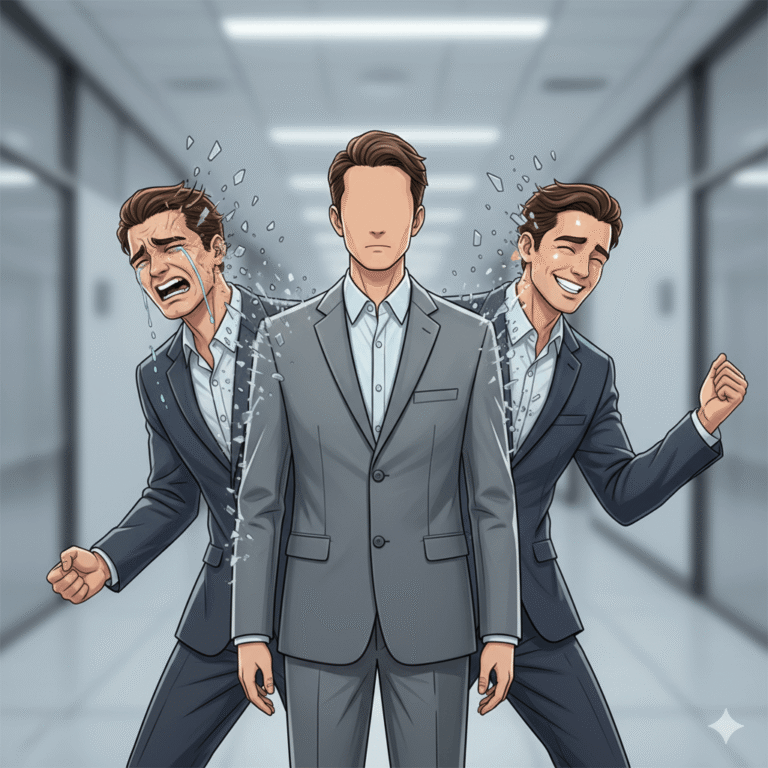

When Motivation Disappears After Burnout: Why Rest Doesn’t Instantly Restore Drive
Have you talked to people in their late 30s or 40s? I have. And there is a pattern I noticed. Some of them are doing excellent in their jobs and roles but whenever a long talk happens, they love to tell their ambitions they had when they were young or teenagers. Why could not they do that? Did something bad happened? I always thought. And sometimes I heard, “Maybe I lost my interest or didn’t actually want it.” “I should rest maybe.”
Both answers are wrong. Both answers come from people who have never experienced the particular hell of post-burnout motivational collapse — a state where the engine is intact but the ignition system is gone.

Let me explain what is actually happening. Not with platitudes. Not with “try a dopamine detox” or “wake up at 5 AM.” But with clinical depth and the kind of honesty that actually helps.
What Post-Burnout Motivational Collapse Actually Is (And What It Is Not)
Post-burnout motivational collapse is a specific neurobiological and psychological state that emerges after prolonged exposure to chronic stress, overwork, or emotional exhaustion — characterized by the dissociation between intention and activation.
In plain language: You can want to do something. You can know how to do it. You can have the energy to do it. And you still cannot initiate it.
- This is not laziness. Laziness is the absence of wanting. You still want and care about it. The wanting is there — trapped behind a door that will not open.
- This is not depression. Though it can look like depression and often co-occurs with it. In depression, anhedonia (the inability to feel pleasure) and hopelessness (the belief that nothing matters) are central. In post-burnout motivational collapse, you can still feel pleasure. You can still believe things matter. You just cannot bridge the gap between wanting and doing.
- This is not a lack of discipline. Discipline requires a functioning prefrontal cortex. After burnout, the prefrontal cortex — the part of your brain responsible for initiation, planning, and impulse control — is exhausted. You are not undisciplined. You are trying to run a car with a dead battery.
- This is not a sign that you chose the wrong path. Your goals can be exactly right for you, and your brain can still be incapable of pursuing them right now. The disconnect is not in your values. It is in your neurobiology.
The Core Question This Article Answers
“I have lost my motivation and rest did rest not bring it back? What will actually work?”
The short answer: Rest restores energy. Motivation is not energy. Motivation is the direction of energy toward a specific goal, fueled by anticipation of reward and the belief that the effort will be worth it. Burnout does not just deplete energy — it damages the motivational circuitry itself. Rest alone cannot repair that circuitry. You need a different set of interventions.
The long answer requires understanding the neuroscience of drive, the psychology of reward prediction, and the specific ways burnout rewires your brain’s relationship with effort. Let’s go there.
The Neuroscience of Motivation: What Burnout Breaks
To understand why rest is not enough, you must first understand what motivation actually is — under the hood, in the wiring.
The Three-System Model of Motivation
Contemporary affective neuroscience distinguishes between three partially independent motivational systems :
| System | What It Does | Brain Regions | What Burnout Does |
|---|---|---|---|
| Liking | The experience of pleasure | Nucleus accumbens (ventral striatum), ventral pallidum | Often intact (you can still enjoy things once started) |
| Wanting | The motivational drive to pursue rewards — the oomph behind desire | Nucleus accumbens (core), ventral tegmental area (dopamine projections) | Severely impaired — this is what breaks in burnout |
| Learning | The ability to predict which actions will lead to rewards | Prefrontal cortex, amygdala, striatum | Disrupted — you stop believing that effort will pay off |
Here is the crucial insight: Liking, wanting, and learning are not the same thing.
You can like something — genuinely enjoy it once you are doing it — and still have no wanting to start it. This is the signature of post-burnout motivational collapse. You are not broken in the pleasure centers. You are broken in the initiation centers.
The Dopamine-Insensitivity Loop
Dopamine is not about pleasure. Dopamine is about anticipation of reward and effort mobilization .
When you are healthy, the prospect of a reward (finishing a project, connecting with a friend, achieving a goal) triggers dopamine release in the nucleus accumbens. That dopamine release translates into energy toward the goal — the feeling of motivation.
Chronic stress and burnout do something different. They downregulate dopamine receptors. Your brain becomes less sensitive to the dopamine it produces. The same reward that used to light up your brain now produces a dim, flickering signal.
Your brain adapts by producing less dopamine overall — a phenomenon called stress-induced dopamine downregulation .
The result is the loop:
- You consider doing something you used to care about.
- Your brain produces a weak dopamine signal (or none at all).
- Without the dopamine signal, there is no felt sense of motivation.
- You interpret the absence of feeling as evidence that you don’t really care.
- You do nothing.
- The lack of action further weakens the dopamine pathways.
It implies that you are running on a dopamine system that has been turned down to protect you from chronic stress — and now it cannot turn itself back up without specific intervention.
The Effort-Value Imbalance
There is a second mechanism at play, equally important.
Every action requires a cost-benefit calculation. Your brain constantly asks: “Is the effort required worth the reward I will get?”
In a healthy brain, the calculation is weighted toward action. Rewards feel valuable. Effort feels manageable.
After burnout, the calculation inverts. Because your dopamine system is blunted, rewards feel less valuable. Because your prefrontal cortex is exhausted, effort feels more costly.
The result is a brain that consistently concludes: “Not worth it.” Not because you are lazy. But because the actual cost-benefit equation has shifted. A task that used to feel like a 30-unit effort for a 70-unit reward now feels like a 70-unit effort for a 30-unit reward.
This is not a perception problem. This is a neurobiological reality. And rest alone does not recalibrate the equation. You have to relearn the relationship between effort and reward — through tiny, repeated experiments that feed your brain new data.
Why Rest Alone Fails: The Four Gaps
You rested. Maybe a lot. Maybe for weeks. And the motivation did not come back. Here is why.
Gap 1: Rest Restores Energy, Not Drive
Sleep, nutrition, and time off restore your body’s energy reserves — ATP, glycogen, muscle repair. These are necessary for motivation. But they are not sufficient.
Drive is generated by the reward system. The reward system is not restored by rest. It is restored by reward itself — by experiencing positive outcomes from effort. You cannot rest your way back to wanting. You have to want your way back to wanting. This is the cruel irony of post-burnout recovery.
Gap 2: Safety-Seeking Overrides Goal-Seeking
After burnout, your nervous system is often in a state of threat sensitivity. It is not looking for rewards. It is looking for safety.
From your brain’s perspective, pursuing goals requires risk: risk of failure, risk of criticism, risk of depletion, risk of re-entering the state that burned you out in the first place.
Your brain will always choose safety over reward when safety feels uncertain. You are not unmotivated. You are hyper-protected. Your brain has put a fence around you to keep you from hurting yourself again — and the fence is working so well that it is keeping out not just danger, but also everything you love.
Gap 3: Identity Disruption
Before burnout, you likely had an identity that included being a motivated person. You were the one who got things done. The early riser. The reliable one. The person with the fire.
After burnout, that identity collapses. And you have not yet built a new one.
Related: Identity Gap: When You Become Someone New Before You Feel Like Someone New- The Emma Story
The identity gap is the space between “I used to be someone who was driven” and “I am currently someone who cannot start.” In that gap, motivation cannot survive, because motivation requires a self that has a relationship with the future. When you do not know who you are anymore, you cannot know what you want.
Gap 4: The All-or-Nothing Trap
Before burnout, you likely operated in a certain gear: high output, high engagement, full commitment.
After burnout, you look at the same gear and it terrifies you. You remember what that gear cost you. So you refuse to engage it at all.
But you have not yet learned that there are other gears. You either go full throttle or you sit still. There is no in-between mapped in your nervous system.
The absence of motivation is not the absence of desire. It is the absence of a modulated desire — a desire that knows how to show up in small, sustainable doses without triggering the memory of collapse.
The Seven Shapes of Post-Burnout Motivational Collapse
Not everyone experiences this the same way. Here are the common presentations. Recognize yours.
Shape 1: The Flatline
What it looks like: You feel nothing about your goals. There is no excitement, anxiety or resistance about it. Just… nothing. You open your to-do list and your mind goes blank.
What is actually happening: Your brain has downregulated emotional response across the board to protect you from overwhelm. You are not apathetic because you don’t care. You are numb because caring used to hurt.
The hidden message: “If I don’t feel anything about my goals, I cannot be disappointed by them.”
Shape 2: The Ghost
What it looks like: You remember wanting things. You remember the feeling of drive. But it feels like it belonged to someone else — a previous version of you that no longer exists.
What is actually happening: Identity disruption. The “you” that was motivated is separated from the “you” that is now. The dissociation is not pathological — it is protective. But it makes motivation feel impossible because motivation requires a continuous self that acts across time.
The hidden message: “That person is not me anymore. I don’t know who I am now, so I don’t know what I want now.”
Shape 3: The Wall
What it looks like: You can plan. You can think about doing the thing. You can break it down into tiny steps. But when you go to take the first step — even something as small as opening a document — you hit a wall. Not a thought. A physical, visceral stop.
What is actually happening: Your nervous system has associated the initiation of effort with the memory of burnout. The moment you try to start, your body activates a freeze response. You are not blocked by lack of will. You are blocked by a somatic alarm.
The hidden message: “Starting is dangerous. Starting led to collapse before. I will not let you start.”
Shape 4: The Perfectionist’s Pause
What it looks like: You cannot start unless you know you can do it perfectly. And you cannot guarantee perfection. So you do nothing.
What is actually happening: Burnout often follows a period of over-functioning — doing too much, too well, for too long. Your brain has learned that engagement leads to exhaustion. The perfectionism is not a personality trait. It is a brake — a way of preventing yourself from engaging at all.
The hidden message: “If I cannot do it perfectly, I should not do it at all. Because doing it imperfectly might lead to doing it more — and doing it more might lead to collapse again.”
Shape 5: The Anxious Starter
What it looks like: You want to start. You try to start. And the moment you do, anxiety floods in. Not about the task itself. Just a generalized wave of dread that has no object.
What is actually happening: Your brain has fear-conditioned the act of goal-directed effort. The anxiety is not about failure. It is about effort itself — because effort has, in the past, been followed by pain. Your brain is not anxious about the task. It is anxious about the memory of what happened the last time you cared this much.
Related: Self-Sabotage After Progress: The “Humble” Mask of a Know-it-All
The hidden message: “Effort hurts. I will protect you from effort by making effort feel unbearable.”
Shape 6: The Avolitional Drift
What it looks like: You do things — but only things that are immediate, reactive, or demanded by others. You respond to emails, show up to appointments. You handle crises. But you never initiate anything for yourself.
What is actually happening: Your brain has shifted from proactive to reactive mode. Proactive motivation (internally generated) requires a functioning reward system. Reactive motivation (externally cued) runs on a different circuit — one that is more resistant to burnout. You are not unmotivated. You are selectively unmotivated — and the selection is not a choice.
The hidden message: “I can do things that are asked of me. I cannot do things I ask of myself. Because asking myself for things reminds me of who I used to be — and that memory is painful.”
Shape 7: The Grieving Stopper
What it looks like: You have accepted that you are not motivated right now. You are not fighting it. You are just… waiting. Waiting to feel different and for the fire to come back. It seems like looking for a sign that has vanished.
What is actually happening: You are grieving. Not consciously. But underneath the waiting is a profound loss — the loss of the version of you that had drive, that woke up hungry, that could trust its own wanting. The waiting is not patience. It is mourning.
The hidden message: “I am not ready to build a new relationship with motivation because I am not finished grieving the old one.”
Related: Pressure to be OKAY All Time- Performative Stability
Interactive Section: Which Shape Is Yours?
Circle the shapes that sound familiar:
- The Flatline (nothing → numbness → no feeling about goals)
- The Ghost (past drive → present dissociation → “that wasn’t me”)
- The Wall (plan → attempt → physical block)
- The Perfectionist’s Pause (imperfect → impossible → nothing)
- The Anxious Starter (effort → dread → avoidance)
- The Avolitional Drift (reactive yes → proactive no → drift)
- The Grieving Stopper (loss → waiting → paralysis)
Now complete this sentence:
“My motivation disappeared after burnout in the shape of ____________. I think my brain is trying to protect me from ____________.”
Name it. It matters.
What Actually Restores Motivation After Burnout (The Protocol)
Rest is not the answer. Rest is the foundation — necessary but not sufficient. What follows are the interventions that actually rebuild the motivational circuitry. They are not quick and sexy. They work.
Phase 1: Stop Waiting for the Feeling to Come Back
This is the most important phase. Read it twice.
You cannot wait for motivation to return before you act. Motivation is not the cause of action. Motivation is the result of action.
In a healthy system, the sequence is: anticipation → motivation → action → reward → reinforcement.
In a burned-out system, anticipation produces no motivation. So you must reverse the sequence: action → small reward → tiny motivation → more action → more reward.
You are not faking it. You are priming the pump. The first actions will be mechanical, joyless, and effortful. That is not a sign that it isn’t working. That is the shape of the work.
Phase 2: Shrink the Goal Until It Cannot Trigger the Alarm
Your brain is blocking action because action feels dangerous. The solution is not to push harder. The solution is to shrink the action until your brain no longer perceives it as a threat.
The One-Minute Rule: Choose one action related to a goal you care about. Do it for one minute. Then stop. Even if you want to continue. Especially if you want to continue.
- Open the document and look at it for 60 seconds. Close it.
- Put on your walking shoes and stand outside for 60 seconds. Go back inside.
- Write one sentence. Not a paragraph. One sentence.
You are not trying to get things done. You are trying to teach your brain: “Effort does not have to mean marathon. Effort can be tiny. Tiny effort is safe.”
Do this for two weeks. No more than one minute per day per goal.
Phase 3: Separate Initiation from Execution
One of the most effective interventions for post-burnout motivational collapse is to split the task:
- Day 1: Set up the conditions for the task. Nothing more.
- Lay out your materials.
- Open the necessary tabs.
- Put your phone in another room.
- Do not do the task.
- Day 2: Do the first 30 seconds of the task. Nothing more.
- Day 3: Do five minutes.
You are teaching your brain that initiation (the hard part) and execution (the easier part) are separate. You are also building task-specific safety — showing your nervous system that this particular goal, in this particular context, is not the same as the burnout that came before.
Phase 4: Rebuild Reward Sensitivity (Dopamine Resensitization)
Your dopamine receptors are downregulated. You need to resensitize them. This is not about avoiding pleasure (dopamine detoxes are largely pseudoscience). It is about calibrating pleasure.
The practice: For two weeks, identify one small, predictable reward that you will give yourself immediately after any effort — no matter how tiny the effort.
- Finished one minute of work? Reward: stand up and stretch.
- Wrote one sentence? Reward: look out the window for 30 seconds.
- Sent one email? Reward: one square of dark chocolate.
The reward does not need to be big. It needs to be consistent and immediate. You are retraining your brain’s expectation: “Effort leads to reward. Rewards feel good. Therefore, effort might be worth it.”
Phase 5: Use External Cues (Offload the Initiation)
Your internal initiation system is broken. So use an external one.
Cue-based initiation: Pick a specific, unchanging external cue that will trigger the action — regardless of how you feel.
- “When I finish my morning coffee, I will open the document and look at it for one minute.”
- “When I sit down at my desk, I will write one sentence.”
- “When I come home from work, I will put on my walking shoes and stand outside for 60 seconds.”
You are not waiting for the feeling. You are following the cue. The cue bypasses the broken motivational system. Over time, the cue itself will begin to generate a tiny anticipatory dopamine signal — not because you want to do the thing, but because your brain has learned that the cue predicts safety.
Phase 6: Name the Grief
You lost something. Not a person. A capacity. The capacity to want easily, to trust your own drive and to wake up hungry.
That loss deserves grief. And un-grieved loss becomes stuck motivation — a door that will not open because you have not yet acknowledged what is on the other side.
The grief practice: Write this letter.
Dear the version of me who was motivated,
I miss you. I didn’t know I would lose you. I didn’t know that caring that much would cost this much. I am angry that you were taken. I am sad that I cannot find you. I am afraid that you might not come back.
But I am not the same person who had you. I am someone new. And I need to learn, from scratch, what wanting looks like for this new person.
I am not betraying you by rebuilding. I am honoring you by not staying stuck in the ashes.
Rest now. I will find a new way.
Phase 7: Redefine Motivation (Lower the Bar Dramatically)
Before burnout, motivation likely meant: eagerness, excitement, automatic drive, waking up ready.
That definition is now toxic for you. Because comparing your current state to that definition will only generate shame. And shame kills whatever fragile motivation might be trying to grow.
New definition of motivation, post-burnout: The willingness to do one small thing, even without the feeling, because you have decided it matters.
That is it. You don’t want fire, passion or eagerness. Just willingness without feeling.
When you accept this definition, you stop waiting to feel motivated. You start choosing to act — not because you want to, but because you have decided that the action aligns with who you want to become.
Interactive Section: Your Post-Burnout Motivation Protocol
Fill this out. Hang it on a wall or keep it somewhere visible.
- My shape of motivational collapse is: ____________
- My one-minute action (for the next two weeks) is: ____________
- My external cue (what will trigger the action) is: ____________
- My immediate tiny reward after the action is: ____________
The new definition of motivation I am accepting is: “Motivation is the willingness to do one small thing, even without the feeling.”
One sentence I will say to myself when the wall appears: “The wall is not a stop sign. The wall is a signal that I am trying to do too much at once. I will shrink the action further.”
FAQ: Real Questions, Real Answers
Q: How long does it take for motivation to come back after burnout?
A: There is no universal timeline, but clinical observation suggests:
- 1–3 months: You can begin to initiate tiny actions with significant effort
- 3–6 months: Small actions become less effortful; you may experience brief flashes of wanting
- 6–12 months: You can sustain moderate effort on meaningful goals; motivation is no longer completely absent
- 12–24 months: Your motivational system may approach pre-burnout baseline — but likely with a different shape (lower ceiling, better boundaries)
The good news: The brain is plastic. The dopamine system can resensitize. But it requires repeated, rewarded effort — not just rest.
Q: What if I try the one-minute rule and still can’t start?
A: Then shrink it further. Thirty seconds. Fifteen seconds. One breath. The action can be thinking about opening the document. The action can be sitting in the chair where you would do the work. If your brain is blocking at one minute, the threshold is lower. Find it. Start there.
Q: Is it possible I don’t actually want the things I used to want?
A: Yes. Burnout can clarify values. Sometimes the motivation disappears because the goal was never yours — it was imposed, expected, or a way of earning worth. That is a different problem with a different solution (values clarification, not motivational repair).
But do not assume this too quickly. Many people assume their goals were wrong because they cannot feel the wanting anymore. Often, the wanting is still there — it is just trapped behind a burned-out nervous system. The test: if you could feel the wanting again, would you want the goal? If yes, the problem is neurobiological, not existential.
Q: Can medication help with post-burnout motivational collapse?
A: Sometimes. Medications that affect dopamine (certain antidepressants, Wellbutrin/bupropion, stimulants for those with ADHD) can be helpful for some people. This is a conversation with a psychiatrist. Do not self-medicate. Do not assume medication is the answer. But do not rule it out either.
Q: What if I never get my old motivation back?
A: Then you will build a new one. And the new one might be better.
Old motivation — the pre-burnout kind — often came with a cost: overwork, porous boundaries, disregard for your own limits, identity fused with output. The new motivation you build, if you do it consciously, can include wisdom that the old motivation lacked. You can want things and rest, pursue goals and pause, can care and not collapse.
The loss of the old motivation is real. Grieve it. But do not mistake the loss for the end. It is the beginning of a different kind of wanting — slower, maybe quieter, but also more sustainable.
A Letter to You, the Reader Who Cannot Find the Wanting
You are still here. That means something in this article landed. Something recognized you. Here is what I need you to hear, directly, with no softening:
You did not lose your motivation because you are weak. You lost it because you used it harder and longer than it was designed to be used. You asked your drive to carry a load that would have broken anyone. And it broke.
Not because it was fragile. Because it was real. Real drive has limits. You hit yours. That is not a character flaw. That is physics.
The motivation will not come back the way you remember it. That version of drive is gone. It served you well. It carried you through years of overwork, through crises, through the impossible. And now it is tired.
You are not starting from zero. You are starting from the ashes of a fire that burned too bright. Ashes are not nothing. Ashes are the residue of heat. The heat was real. The heat is not gone. It is just… buried.
You will not dig it out with willpower. You will dig it out with tiny, mechanical, joyless actions taken day after day, not because you want to, but because you have decided that the person you are becoming is worth the effort of learning to want again.
The first time you feel a flicker — not the old fire, just a flicker — you might not even trust it. You might think it is a trick. It is not a trick. It is the first sign that the ash is warming.
Stay with the tiny actions. Shrink them until they cannot trigger the alarm. Reward them immediately. Use external cues. Name your grief. Lower your definition of motivation until it is humble enough to fit in the palm of your hand.
The wanting will return. Not because you fought for it. Because you made space for it. And then you waited. And then you acted — without the feeling — until the feeling remembered that it was safe to come back.
That is not a quick fix or hack. That is the actual shape of healing a burned-out motivational system. And it works. Not overnight. Not without setbacks. But it works.
Stay with the one-minute actions, with the grief and stand by the decision that you are worth rebuilding.
The fire is not dead. It is just underground. And you are learning a new way to feel its warmth.
About Readanica
*This article is part of Readanica’s Phase 4: HEALING-ADJACENT series, exploring the deeper, trust-building dimensions of recovery. We do not offer quick fixes. We offer understanding, evidence, and the hard-won wisdom of those who have walked the path.*
If this article helped you, consider sharing it with someone who needs to hear that the absence of motivation after burnout is not a moral failure — it is a neurobiological reality with a path forward.
Sources & Further Reading
- Berridge, K. C., & Robinson, T. E. (2016). Liking, wanting, and the incentive-sensitization theory of addiction. American Psychologist, 71(8), 670–679.
- Salamone, J. D., & Correa, M. (2012). The mysterious motivational functions of mesolimbic dopamine. Neuron, 76(3), 470–485.
- Arnsten, A. F. T. (2009). Stress signalling pathways that impair prefrontal cortex structure and function. Nature Reviews Neuroscience, 10(6), 410–422.
- Pizzagalli, D. A. (2014). Depression, stress, and anhedonia: toward a synthesis and integrated model. Annual Review of Clinical Psychology, 10, 393–423.
- Baumeister, R. F., et al. (2007). The strength model of self-control. Current Directions in Psychological Science, 16(6), 351–355.
- Kool, W., & Botvinick, M. (2018). Mental labour. Nature Human Behaviour, 2(12), 899–908.
- Herman, J. L. (2015). Trauma and Recovery. Basic Books. (For identity disruption after prolonged stress)