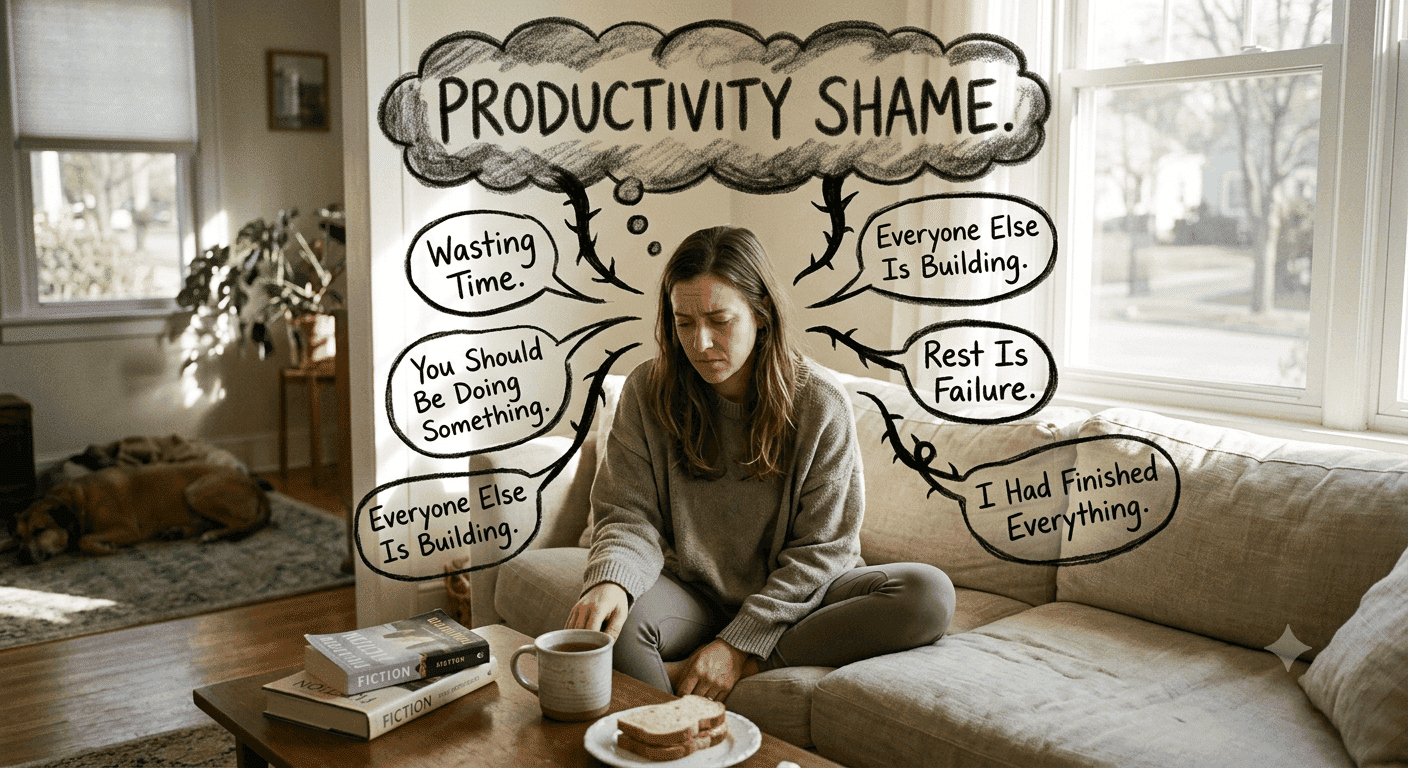
Productivity Shame: Why Doing Nothing Makes You Feel Like You’re Failing
Sitting idle sucks bro. And that’s what I have been facing since childhood. ADHD has played a significant role in it but sitting down or getting to lie peacefully after a busy day never seems relaxing. Instead, it is another kind of performance to get your body to rest. And with all these things swirling and twirling in mind, you remember that X, whom you met 5 years ago is doing Y today; so you go crazy about wasting those 5 minutes. And with it comes the question, “What’s wrong with me?”
It is productivity shame.
The feeling of shame that you are not productive enough. It is the voice that tells you that you have not done enough, even when you have done more than enough. It is the anxiety that creeps in the moment you try to rest, making relaxation feel like a crime you are committing against your own potential.
And I finally named it.
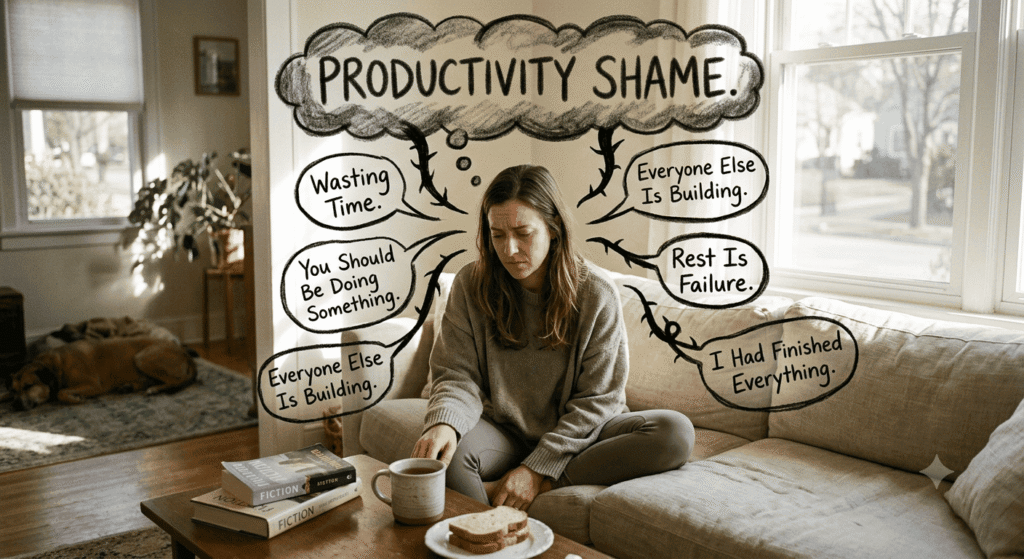
What Productivity Shame Actually Is
Productivity shame is not laziness. It is not a lack of ambition or an impression that you do not care about your work or your life.
Productivity shame is the feeling of inadequacy that appears when you perceive yourself as not being productive enough. It is the mere belief that your value as a person is measured by what you produce. When you are not producing, even when you are resting, recovering, or simply being, you feel like you are failing.
The core insight: Productivity shame is not about how much you actually accomplish. Instead, it is about the gap between what you do and what you believe you should do. This gap is created by conditioning, not by reality.
Related: Are You Feeling Behind Your Colleagues? Comparison Anxiety
The Core Question
“Why does doing nothing make me feel like I am failing, even when I have done enough?”
The short answer is that you have been taught, through years of conditioning, that your worth is earned through output. Rest feels wrong because it contradicts the belief that you must constantly prove your value.
The long answer is that productivity shame is not a personal failing. Rather, it is a cultural condition that has been built into you so deeply that it feels like the truth.
Where It Comes From
I have traced the feeling of shame when you are not productive enough back to three sources.
Source 1: Self-Worth Tied to Achievement
Somewhere along the way, you learned that your value as a person is tied to what you accomplish. The more you do, the more you are worth. The less you do, the less you matter.
This is not a conscious belief. Instead, it is an internalized one. It comes from childhood messages, cultural narratives, social media, and work environments that reward output and punish rest.
When your self-worth is tied to achievement, rest becomes threatening. After all, rest means you are not achieving. And if you are not achieving, what are you worth?
Source 2: Unrealistic Goal Setting
The second source is setting goals that cannot be met. Not because you are incapable, but because the goals are designed to be unachievable.
You set the bar high. Then higher. Then higher still. Each time you clear it, you raise it again. Consequently, there is no finish line because the finish line keeps moving. When you inevitably fall short — because the goal was never reachable — you feel shame.
Source 3: The Comparison Trap
The third source is comparison. You look around and see others who seem to be doing more, achieving more, hustling harder. You do not see their exhaustion, their moments of collapse, or their private struggles. Instead, you see the curated version, the highlight reel, the public face of success.
You measure yourself against it. And you always come up short.
The Seven Signs
Productivity shame shows up in different ways. Recognize yours.
Sign 1: The “Never Enough” Feeling
You finish a productive day. You check off everything on your list. Nevertheless, you feel like you could have done more. You should have done more.
The hidden message: “No amount of work will ever make me feel like I have done enough.”
Sign 2: The Guilt of Rest
Sitting down to relax? Trying to watch a show? Just trying to be? Within minutes, however, the guilt creeps in.
The hidden message: “Rest is not allowed unless I have earned it. And I have never earned enough to deserve rest.”
Sign 3: The Inability to Disconnect
Still check emails on vacation? Working through weekends? You think about work when you are not working.
The hidden message: “If I stop, everything will fall apart.”
Sign 4: The Diminished Satisfaction
You complete a project, hit a milestone. You achieve something significant. Yet you feel… nothing.
The hidden message: “Accomplishments are not for celebrating. They are for crossing off.”
Sign 5: The Panic of Unscheduled Time
A weekend with no plans. A holiday with no agenda. A day with nothing on the calendar. Instead of relief, however, you feel panic.
The hidden message: “Time without structure is time I should be filling.”
Sign 6: The Self-Worth Equation
You measure your day by what you accomplished. A “good day” means you got things done. A “bad day” means you did not.
The hidden message: “I am only as good as what I produce today.”
Sign 7: The Burnout Cycle
You work until you cannot work anymore. Then you crash and feel guilty for crashing. So you work harder to make up for the crash. And you crash again.
The hidden message: “This is just how it is. I do not have a choice.”
Related: Silent Burnout Is Real. Here Are 3 Signs You’re Running on Empty (And How to Recover)
Why It Is So Hard to Break
Productivity shame is not just a thought. It is also a nervous system response.
Your brain has learned, through years of conditioning, that productivity equals safety. When you are productive, you are safe, valuable, and acceptable. Conversely, when you are not productive, you are unsafe, worthless, and a failure.
This is not a logical belief. Instead, it is a survival belief. Your brain does not care if the belief is true. It cares that the belief kept you alive in the past.
When you try to rest — when you try to stop producing — your brain sounds the alarm. “Danger. You are not doing anything. You are not safe. Get back to work.”
That is why rest feels wrong. Not because rest is wrong. Because your brain has been trained to treat rest like a threat.
How to Heal It
You cannot think your way out of productivity shame. You have to retrain your brain and your nervous system.
Step 1: Decouple Self-Worth from Output
You need to separate who you are from what you do.
Practice: Every day, name one thing that is true about you that has nothing to do with your productivity.
- “I am someone who notices small kindnesses.”
- “I am someone who makes my partner laugh.”
- “I am someone who likes the sound of rain.”
These are not productivity metrics. Rather, they are proof that you exist outside your to-do list.
Step 2: Redefine Productivity
Productivity is not just output. In fact, it also includes recovery, creativity, emotional regulation, and connection.
Practice: Create a personal definition of productivity that includes rest.
“Being productive means using my time in a way that supports my well-being and my goals — including time to relax.”
Step 3: Schedule Rest Intentionally
Rest feels most restorative when it is intentional, not a byproduct of burnout.
Practice: Block out rest periods on your calendar. Treat them like meetings. You are not asking permission to rest. Rather, you are telling your brain that rest is non-negotiable.
Step 4: Challenge Negative Self-Talk
Productivity shame is fueled by distorted thinking patterns. Recognize them for what they are: thoughts, not facts.
Practice: When you think “I am wasting time,” counter it with: “This break is helping me return to my work more focused.”
Step 5: Practice Self-Compassion
We are often much harder on ourselves than we would ever be on a friend.
Practice: Ask yourself, “What would I say to a friend in this situation?” Then say it to yourself.
Step 6: Use Micro-Rest
If rest feels threatening, start small. Five minutes. Ten minutes. A pause between tasks.
Practice: Sit. Breathe. Do nothing. Let your body experience rest in small, manageable doses.
Step 7: Celebrate Doing Nothing
Instead of treating rest as something to be earned, try celebrating it.
Practice: Start a small “rest journal.” Track moments of intentional relaxation and how you felt afterward.
The Voice That Tells You to Keep Going
Productivity shame has a voice. It sounds different for everyone, but it always says the same thing.
You know the voice. You have heard it a thousand times.
- “You should be doing more.”
- “Everyone else is grinding harder than you.”
- “This is not enough. You are not enough.”
- “If you stop now, you will fall behind.”
- “Rest is for people who have earned it.”
That voice is not the truth. Instead, it is the noise of conditioning. It is the echo of every time someone told you that you needed to be more. It is the whisper of a culture that profits from your exhaustion.
That voice is not your voice. You do not have to obey it.
A Letter to You
You did not choose to feel this way. It’s inherited from a culture that equates worth with output, from a childhood where achievement was rewarded and rest was dismissed. You inherited it from a world that told you that you must earn your value.
That world was and will be wrong.
You are not your output, or to-do list or number of emails you answered or the projects you completed or the hours you worked. You are a person. Not a machine.
I repeat it again. Rest is not a reward. It isn’t to be earned. It is what you do because you are a human and humans need to pause.
The guilt you feel when you rest is not a signal that you are lazy. Instead, it is a signal that you have been conditioned to believe that your worth depends on your work.
Conditionings can be unlearned. Slowly. With practice, compassion and the understanding that you are not broken — you are just running an old program that needs to be updated.
Let the guilt come. Do not obey it. Sit with it. Notice it. Then rest anyway.
You do not need to prove your worth by being productive. You are worthy simply because you exist.
About Readanica
This article is part of Readanica’s series on sustainable performance and mental well-being. We do not offer quick fixes. We offer understanding, evidence, and the hard-won wisdom of those who have walked the path.
Sources & Further Reading
- YourTango. (2023). 6 Signs You Developed ‘Productivity Shame’ In Childhood & It’s Affecting You Now.
- RescueTime. (2024). Embracing Productivity Grace: Overcoming Shame for a Positive Work Mindset.
- Sarah Cline & Associates. (2025). Why You Feel Guilty Every Time You Rest: Understanding Productivity Shame.
- Manoshala. (2024). The Rise of “Productivity Shame” in the Age of Hustle Culture.
- Psychology Today. (2025). The Hidden Cost of Always Being Productive.
- Healthline. (2025). Productivity Guilt: What It Is and How to Manage It.
- Centerstone. (2026). What Does it Mean to be “Enough”?
- Harper’s Bazaar India. (2025). When did doing nothing become so uncomfortable?