Emotional Intelligence and Sustainable Success
What Emotional Intelligence and Sustainable Success Is?
A friend texted me at 11 PM. She had just gotten home. Again. She said: “I don’t even know why I’m tired. Nothing bad happened.”
I wrote back: “You don’t need a bad thing to happen to be exhausted.”
She said: “Then why do I feel guilty for being tired?” I did not have an answer that night.
But I thought about it for days. About her. About everyone I know who is successful and exhausted. Who has everything they wanted and feels nothing. Who cannot tell the difference between a good day and a day that did not kill them.
They are not broken. They are just running on a version of success that was never designed to last. And no one taught them the one skill that actually protects you. Not hustle. Not boundaries. Not meditation.
Emotional intelligence. Not the corporate kind. The real kind. The kind that catches your brain lying to you before you believe the lie.
That is what this article is about.
That is not emotional intelligence. That is performance. And performance exhausts you. Real emotional intelligence is not about managing other people’s emotions. It is about recognizing when your own brain is lying to you. It is about knowing the difference between pressure and threat. It is about building a version of success that does not require you to disappear.
Let me show you what that actually looks like.
What Emotional Intelligence Actually Is (And What It Is Not)
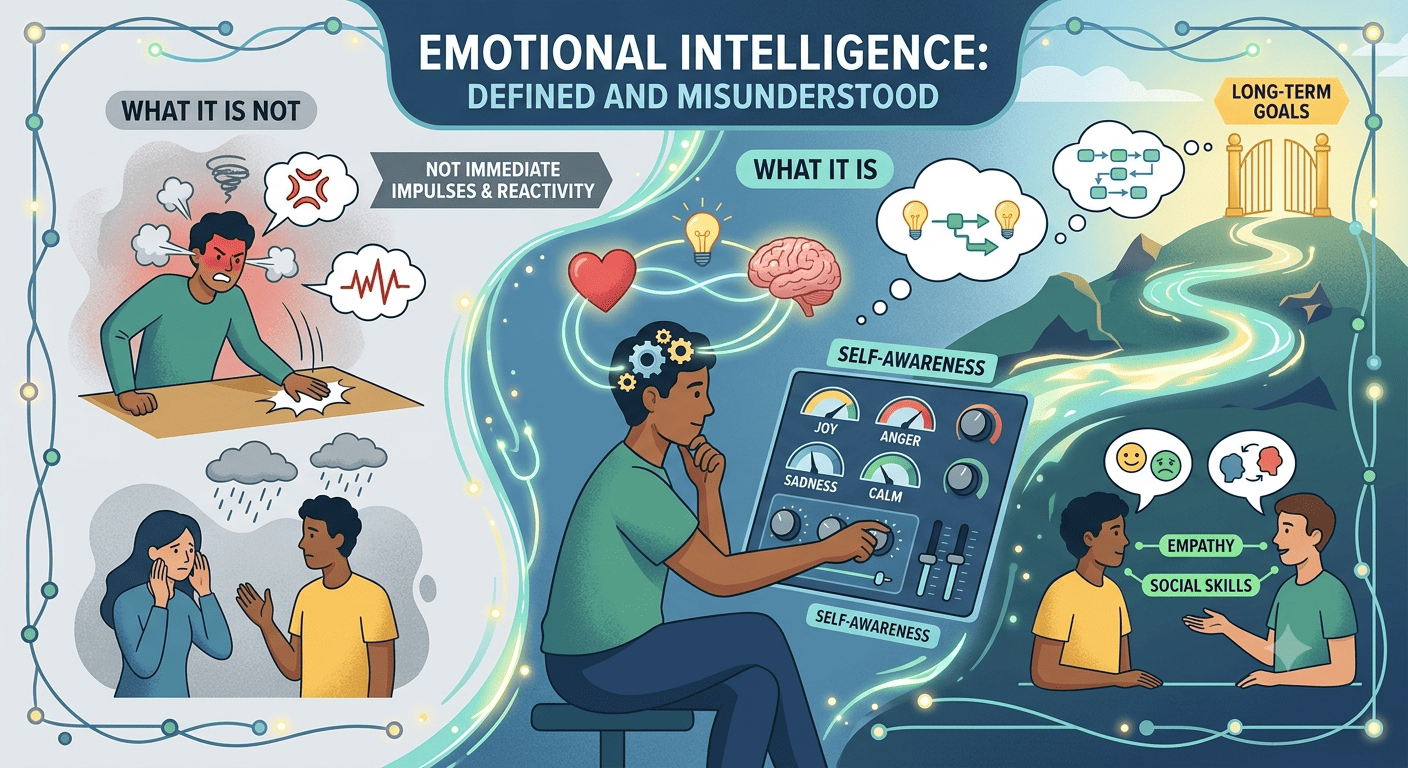
Emotional intelligence is the capacity to recognize, interpret, and respond to emotional information — both in yourself and in others — in ways that serve your long-term goals rather than your immediate impulses.
That is the definition. Here is what it means in practice.
| Emotional Intelligence is NOT… | Emotional Intelligence IS… |
|---|---|
| Being nice all the time | Knowing when nice serves you and when it does not |
| Suppressing anger | Recognizing what anger is telling you |
| Never showing stress | Knowing what stress means and responding appropriately |
| Making everyone comfortable | Telling the truth even when it is uncomfortable |
| Being “professional” (emotionless) | Being strategic about what you show and what you keep |
| Avoiding conflict | Choosing which conflicts matter |
The core insight: Emotional intelligence is not about having different emotions. It is about having a different relationship with the emotions you already have.
The most emotionally intelligent people you know are not the ones who never get angry, never feel afraid, never crack under pressure. They are the ones who notice anger before it becomes destruction. Who feel fear and act anyway. Who crack in private and reassemble in time for what comes next.
They are not unfeeling. They are undeluded.
The Core Question This Article Answers
“How does emotional intelligence actually help me build success that lasts?”
The short answer: Because sustainable success is not about avoiding failure. It is about surviving failure. It is about not burning out. It is about knowing which voices to listen to and which to ignore. Emotional intelligence is the filter that separates signal from noise.
The long answer requires understanding the three specific ways your brain lies to you under pressure and how emotional intelligence gives you a way to see through the lies.
The First Lie: “This Feeling Means Something”
Your brain is a prediction engine. It is constantly scanning for threats and opportunities. And it produces feelings to motivate you to act.
The lie: The feeling means the situation is dangerous.
The truth: The feeling means your brain predicts the situation is dangerous based on old data.
Here is the distinction that changes everything. A feeling is not a fact. A feeling is a hypothesis about the world. Your brain is guessing. Sometimes it guesses correctly. Sometimes it guesses based on a map drawn in a warzone you are no longer in.
Emotional intelligence is the capacity to pause and ask: “Is this feeling a signal or a ghost?”
- Signal: There is a real threat. I need to act.
- Ghost: There was a threat once. My brain is replaying the tape.
The practice: When a strong emotion rises — fear, anger, shame, panic — do not obey it immediately. Do not suppress it. Ask one question: “What would I see if I was not feeling this?”
The answer is often: “I would see that nothing is actually wrong right now. I would see that I have handled this before. I would see that the danger is not here.”
Sustainable success requires this pause. Without it, you are not making decisions. You are reacting to ghosts.
The Second Lie: “Pressure and Threat Are the Same”
This is the most destructive lie in high-pressure environments. And your brain tells it to you constantly.
The lie: This demand is urgent. If I fail, something terrible will happen. I cannot afford to make a mistake.
The truth: Most of what you call threat is actually pressure. And pressure is survivable.
| Threat | Pressure |
|---|---|
| Your life is in danger | Your ego is in danger |
| Someone you love is in danger | Someone you respect might be disappointed |
| You will lose something irreplaceable | You might lose something replaceable |
| Requires survival response (fight/flight/freeze) | Requires executive function (planning, focus, effort) |
| Ends when the danger ends | Ends when the demand ends |
The problem: Your nervous system does not naturally distinguish between pressure and threat. A deadline feels like a predator. A critical email feels like an attack. A mistake feels like a wound.
Emotional intelligence is the capacity to teach your nervous system the difference. To recognize that most of what you are feeling is pressure, not threat. To respond with strategy, not panic.
The practice: When you feel the weight, ask: “If I fail at this, will I die? Will someone I love die? Will I lose everything I cannot rebuild?”
If the answer is no, it is pressure. Pressure is manageable. Pressure does not require emergency response. Pressure requires attention, not adrenaline.
Sustainable success requires this distinction. Treating pressure like threat burns you out. It keeps your cortisol high, your sleep poor, your patience thin. It convinces you that you are in a warzone when you are actually in an office.
The Third Lie: “I Should Be Able to Handle This”
This is the lie that keeps you from asking for help. From taking a break. From admitting that you are struggling.
The lie: Other people can handle this. There is something wrong with me that I cannot.
The truth: Everyone has a limit. The people who seem to have no limit have just gotten better at hiding their breaking.
Emotional intelligence is the capacity to recognize your own limit before you hit it. To know that handling it does not mean handling it alone. To know that rest is not weakness. To know that asking for help is not failure.
The practice: Every time you catch yourself thinking “I should be able to handle this,” replace it with: “I am handling this. And I am allowed to need something.”
Sustainable success requires this honesty. The people who burn out are not the ones who have limits. Everyone has limits. The people who burn out are the ones who refuse to acknowledge their limits until the limits refuse to be ignored.
Related: How to Build Mental Resilience in High-Pressure Environments
The Fourth Lie: “Success Means Never Failing”
This is the lie that makes you fragile. That makes one mistake feel like a catastrophe. That makes you avoid risks, hide your struggles, and pretend you have everything under control.
The lie: If I fail, I am a failure.
The truth: Failure is data. It is information about what does not work. It is not a verdict on your worth.
Emotional intelligence is the capacity to separate outcome from identity. To fail at something without believing you are a failure. To make a mistake without believing you are a mistake.
The practice: When you fail, say: “I did something that did not work. That is all. I am still here. I am still capable. I will try something else.”
Sustainable success requires this separation. Without it, every failure is a wound. With it, every failure is a lesson. And lessons are how you get better.
Related: Productivity Shame: Why Doing Nothing Makes You Feel Like You’re Failing
The Fifth Lie: “I Don’t Have Time to Feel”
This is the lie of high-pressure environments. The lie that says emotions are inefficient. That feelings are obstacles. That the best professionals are the ones who leave their emotions at the door.
The lie: Feeling takes time I do not have.
The truth: Not feeling takes more time. Suppressed emotions do not disappear. They leak. They show up as irritability, as exhaustion, as poor decisions, as snapped relationships, as sleepless nights. They take more time than feeling ever would.
Emotional intelligence is the capacity to feel efficiently. To recognize an emotion, name it, understand its message, and respond — in minutes, not hours. To process without getting stuck.
The practice: When you notice an emotion, spend 60 seconds with it. That is all.
- Name it. (“I am angry.”)
- Locate it in your body. (“My chest is tight.”)
- Ask what it is telling you. (“Something I care about is being threatened.”)
- Decide what to do. (“I will address it after this meeting.”)
Sixty seconds. Not a therapy session. Not a meditation retreat. Just enough time to acknowledge so the feeling does not have to scream for attention.
Sustainable success requires this efficiency. The alternative is not no feelings. The alternative is unmanaged feelings. And unmanaged feelings run the show.
How Emotional Intelligence Prevents Burnout
Burnout does not happen because you work too hard. Burnout happens because you work too hard without enough recovery, without enough meaning, without enough control.
Emotional intelligence addresses all three.
| Burnout Driver | What Emotional Intelligence Does |
|---|---|
| Lack of recovery | Recognizes break indicators before collapse. Schedules recovery before it is needed. |
| Lack of meaning | Separates worth from output. Remembers who you are outside the work. |
| Lack of control | Distinguishes between what you can change and what you cannot. Focuses energy where it matters. |
The emotionally intelligent person does not work less. They work differently. They know when to push and when to pause. They know which battles are theirs and which are not. They know that sustainable success is a marathon, not a sprint — and they pace themselves accordingly.
The Seven Signs Your Emotional Intelligence Is Actually Working
Not what it looks like from the outside. What it feels like from the inside.
| Sign | What It Feels Like |
|---|---|
| You catch the lie | You feel panic rising. You pause. You ask: “Is this threat or pressure?” You realize it is pressure. You breathe. |
| You name the feeling | You are angry. You say “I am angry” to yourself. The anger does not disappear. But it stops running you. |
| You know your limit | You feel the edge approaching. You do not wait for the crash. You pull back. You rest before you break. |
| You ask for help | The words still feel strange. But you say them anyway. And nothing terrible happens. |
| You separate outcome from identity | You fail at something. You notice the urge to say “I am a failure.” You do not say it. You say “That did not work.” |
| You let something burn | You choose what not to do. You feel the anxiety. You do not rescue it. It burns. The world keeps turning. |
| You feel and keep moving | You feel the weight. You name it. You locate it. You ask what it is telling you. You decide. You move. |
Interactive Section: Your Emotional Intelligence Map
The last time I felt panic at work, was it threat or pressure?
Threat: ____________
Pressure: ____________
The last time I thought “I should be able to handle this,” what did I actually need?
I needed: ____________
The last time I failed at something, did I think “I failed” or “I am a failure”?
What I thought: ____________
What I could have thought instead: ____________
One emotion I have been suppressing: ____________
Sixty seconds I will spend with it today: ____________
My break indicator (the whisper before the scream): ____________
One thing I will let burn this week: ____________
FAQ: Real Questions, Real Answers
Q: Is emotional intelligence something you are born with?
A: No. Emotional intelligence is a skill. It is built through practice. Some people have a head start because of their upbringing. But everyone can improve. The research on neuroplasticity shows that the brain changes with repeated experience. Every time you pause before reacting, you are rewiring your brain for emotional intelligence.
Q: What if I am too tired to practice emotional intelligence?
A: Then you are already past your limit. The most emotionally intelligent thing you can do is rest. Not “push through.” Rest. Emotional intelligence requires energy. If you have no energy, you have no emotional intelligence. That is not a failure. That is a signal.
Q: How is emotional intelligence different from being a people-pleaser?
A: People-pleasing is emotional intelligence used against yourself. You read others’ emotions accurately. You respond to keep them comfortable. You suppress your own needs. Emotional intelligence, properly used, includes your own emotions in the calculation. It asks: “What do I need? What do they need? How do we both get what we need?” Not: “How do I make them happy?”
Q: Can emotional intelligence be used manipulatively?
A: Yes. Emotional intelligence is a tool. Like any tool, it can be used for harm. Manipulation is emotional intelligence without empathy. Sustainable success requires both. Without empathy, you may win in the short term. You will not last. People leave. Trust erodes. Reputations crumble.
Q: What is the fastest way to improve emotional intelligence?
A: The pause. The single second between feeling and acting. That is where emotional intelligence lives. You do not need to meditate for an hour. You need to practice the pause. Every time you pause, you create space. In that space, choice lives. Practice the pause.
Q: When should I seek professional help?
A: If you cannot feel anything. If you feel everything all the time. If your emotions are interfering with your ability to work, love, or rest. If you have tried these practices for several months and feel stuck. A therapist can help you identify patterns that self-help cannot reach.
A Letter to You, the Reader Who Is Tired of Performing
You have been told that success means being strong. That strength means not feeling. That not feeling means not breaking. That not breaking means winning.
Those are lies. They were told to you by people who needed you to keep producing. They were told to you by a culture that profits from your exhaustion. They were told to you by a version of yourself that did not know there was another way.
Real emotional intelligence is not about being nice. It is about being real. It is about knowing when your brain is lying to you. It is about knowing the difference between pressure and threat. It is about knowing your limits before you hit them. It is about asking for help before you collapse. It is about letting some things burn so you can protect what matters.
Sustainable success is not about never failing. It is about surviving failure. It is about learning from failure. It is about building a version of success that does not require you to disappear.
You do not have to be the calmest person in the room. You do not have to have everything under control. You do not have to handle it alone.
You just have to pause. Just for a second. Just long enough to ask: “Is this real or is my brain lying to me?”
That pause is emotional intelligence. That pause is the difference between burning out and lasting. That pause is where sustainable success begins.
Let yourself feel. Let yourself fail. Let yourself rest. Let yourself ask for help.
That is not weakness. That is the only path to success that does not kill you.
About Readanica
This article is part of Readanica’s series on sustainable performance and emotional intelligence. We do not offer quick fixes. We offer understanding, evidence, and the hard-won wisdom of those who have walked the path.
Sources & Further Reading
- Goleman, D. (1995). Emotional Intelligence: Why It Can Matter More Than IQ. Bantam Books.
- Brackett, M. A. (2019). Permission to Feel. Celadon Books.
- Sapolsky, R. M. (2004). Why Zebras Don’t Get Ulcers. Holt Paperbacks.
- Kabat-Zinn, J. (2013). Full Catastrophe Living. Bantam Books.
- Davidson, R. J., & Begley, S. (2012). The Emotional Life of Your Brain. Hudson Street Press.